
The Year That Was and Wasn’t
We asked some of our favorite journalists, writers, and thinkers: What were the most important events of 2025, and what were the least?
Interviews by Hayden Higgins
2025 was: Joanna Kavenna on unreality / Luke O’Neil on what’s changed / Miles Klee on the point of no return / Amirio Freeman on basic needs / Erik Baker on ceasefires / Ryan Dombal on ethical streaming / Jane Borden on demagoguery / Mattie Lubchansky on paying attention / Advait Arun on speculation / Deena Mousa on our AI-addled economy / Ryan Broderick on your video future / Tim Hirschel-Burns on the fragility of it all / Doug Mack on human connections / Brooke Borel on slash-and-burn governance / Olivia Messer on doing journalism now / Pete Davis on local patriotism / Margaret Howie on cringe / Nicholas Jackson on selling versus seeing / Niko Stratis on community / David Covucci on Bluesky / Daniel Whiteson on an anti-science year / Rax King on Sandwich Guy / Ted Scheinman on death cults / Susannah Breslin on seeking joy / Tiana Reid on what’s truly important
Joanna Kavenna
Reality often seems quite unreal, because of all the weird things that keep happening.
Most important: …is the event that really happened as opposed to the deep fake event that never really happened at all, despite fake-evidence to the contrary.
The Duck Test as applied to AI slop used to run like this: If it looked like a duck, quacked like a duck, but was labeled a DUK and only had one foot then it probably wasn’t a duck after all. This was quite reassuring. Fakes seemed fake and real stuff seemed, well, real. Yet this has all changed. Now, if it looks like a duck, quacks like a duck, etc., then who knows what the hell it is? This is not reassuring. To confuse everything further, reality often seems quite unreal, because of all the weird things that keep happening. (To name just a few: the World Humanoid Robot Games, the rise of the robots in general, billionaires in space, and those people who claim LLMs have “minds.” Not to mention those people who keep talking about ducks.)
2025 was the year of fakes upon fakes, deep and deeper fakes. By contrast, the most important event/s of 2025 were those precious, beautiful, fragile moments when you, or I, could say: “This is not fake. It may even, perhaps, be real…”
Least important: ChatGPT solemnly informed me that it has stopped hallucinating. (Meaning “it (ostensibly) no longer makes stuff up.”) ChatGPT used to hallucinate (it explained) when “I felt uncomfortable with uncertainty.” Now: “I feel comfortable with uncertainty.” Lovely words. Yet, a caveat: ChatGPT has no self, no “I,” no feelings. It can’t feel “comfortable with uncertainty.” It can’t feel anything at all. Therefore this claim that ChatGPT no longer hallucinates is, itself, a hallucination.
Here’s to 2026. May it be less weird.
Joanna Kavenna is the author of Zed (Random House) and Seven (forthcoming 2026 Faber US) among other novels. / joannakavenna.com
Luke O’Neil
I genuinely do not believe we can go on like this forever.
Most important: There are masked unaccountable federal agents assaulting citizens and non-citizens alike in the streets of major cities across the country. People are being disappeared and tortured on a daily basis at the whims of a rapidly deteriorating madman and the racist eugenicists in his employ. We are carrying out extrajudicial murders in international waters without even bothering to concoct plausible justifications for doing so.
None of this is particularly new of course. I know that and you know that. Much of it is simply the table stakes of existing in the United States and has been for my entire life. Some number of millions must always be made to suffer for the rest of our comfort and sense of “safety.” But it is nevertheless worse than usual. Bad things can always get worse and seem to be well on their way to just that.
One heartening thing is that there have been so many groups of decent people who have recognized how horrifying all this is and are organizing in their communities to stop it. I genuinely do not believe we can go on like this forever. You have to believe that we cannot. There’s no other point in going on otherwise.
Least important: My new book of stories and poems, We Had It Coming, which just so happens to largely be about the suffering we distribute throughout the world and here at home. I’ve been very fortunate to have so many readers who love my work, and whose support allows me to make my living, and I got to meet so many of them out on tour this fall, but I was kind of hoping that this might be the one to break through to a larger audience. Guess not. Fuck me. Still gonna start writing the next one though. There’s no other point in going on otherwise.
Luke O’Neil is the editor of the Welcome to Hell World newsletter and the author of four books, including the most recent collection We Had It Coming. / Bluesky
Miles Klee
We’re seeing historic consequences of this vaunted and despised technology.
Most important: I’m revealing my shameless bias here, since I just wrote a big year-end piece on the topic: AI crossed the point of no return. From DOGE’s reckless use of this tech to ravage the administrative state to Trumpworld’s embrace of fascist slop memes, the explosion of so-called “AI psychosis” and wrongful death lawsuits from parents of teens who died by suicide after talking to chatbots, we’re seeing historic consequences of this vaunted and despised technology. On top of that stuff, we’ve bet the whole US economy on hundreds of billions of dollars in new commitments for resource-draining data centers.
Least important: Severance season two. I was out on this show before the end of season one, recognizing it for the kind of puzzle-box, homework-as-prestige-entertainment that’s bound to disappoint us by the time it limps to a conclusion, mostly because the creators start out with only the vaguest idea of where it will go and eventually start scouring Reddit fan theories for plot twist ideas. One could argue that the final season of Stranger Things is even less important, but at least it means Netflix can finally memoryhole that nostalgia-bait garbage and get to work on something even worse. Onward and downward!
Miles Klee is a culture writer for Rolling Stone who lives in Los Angeles with his partner, the artist Mads Gobbo; they just published a collaborative story collection called Double Black Diamond. / Bluesky, X
Amirio Freeman
The most basic of all basics—food—became a political weapon.
Most important: During what turned out to be the longest government shutdown in US history, Supplemental Nutrition Assistance Program benefits were disrupted for the first time ever. Just when many thought the Trump 2.0 regime couldn’t be more cruel, the most basic of all basics—food—became a political weapon (fucking hell).
As a daytime comms girlie who has worked on anti-hunger policy for nearly a decade, I had never seen so much attention placed on SNAP. For weeks, I couldn’t escape social carousels squashing SNAP myths or food justice veterans receiving overdue shine. 2025 could be the year we look back on as the one that ushered in renewed energy, especially grassroots, for rethinking our food system from top to bottom (hell yeah).
Least important: While making it harder for most folks in America to access food and other essentials, the administration has been gearing up, nonetheless, to celebrate America as we approach the nation’s semiquincentennial, or 250th “birthday.”
Throughout the year, we’ve gotten teasers of the kinds of commemorative programming and efforts we can expect: everything from AI-assisted retellings of American history to, inexplicably, a White House UFC event. What ties everything together—beyond tackiness—is a continued investment in a myth of this country that was never true. White supremacy, American exceptionalism, Christian nationalism, and eugenicist thinking continue working overtime, using tactics that have never felt more tired or banal—only affirming that something new and better for our country is on the horizon.
Amirio Freeman (any pronouns) is an essayist and interviewer exploring Black and queer interspecies histories. Amirio is from coastal VA and currently resides in Philadelphia, PA. / amiriofreeman.com
Erik Baker
Israel’s de-facto annexation of the West Bank has only accelerated.
Like millions of AI-equipped students nationwide, I’m going to cheat a bit. The most important thing that happened in 2025 was the “ceasefire” in Gaza, important precisely because it was, from a different perspective, the least important thing that happened in 2025. Since peace was declared, Israel has killed more than 400 Palestinians and wounded over 1,000 more, while its de-facto annexation of the West Bank has only accelerated. The ascension of the geopolitical event into a symbolic heaven utterly detached from the facts on the ground is a grave portent.
Erik Baker teaches history at Harvard. He is Senior Editor at The Drift and the author of Make Your Own Job: How the Entrepreneurial Work Ethic Exhausted America. / erikmbaker.com, Bluesky
Ryan Dombal
Spotify is not the answer.
Most important: As a longtime music journalist, I devote an unhealthy amount of thought to not only what I listen to, but how I listen to it. And this year marked a tipping point for conscientious music fans and artists’ relationship with the biggest player in streaming, Spotify. Since the advent of widespread music streaming, it’s been common knowledge that pretty much all of these companies devalue music—it’s one reason why Taylor Swift herself took her albums off Spotify back in 2014 (only to put it back a few years later). But this year, not a month seemed to go by without another damning headline about Spotify, whether it was news of CEO Daniel Ek’s investment firm funding war drones, or reports of “ghost artists” filling popular playlists with modern-day Muzak, or how the company was taking money from the US government to run ICE recruitment ads. All of it was too much for a growing number of artists—including Massive Attack, King Gizzard & the Lizard Wizard, and Hotline TNT—who made a point of removing their music from the platform. (I went ahead and canceled my own paid account over the summer, too.) Beyond individual actions, systemic change is also on the horizon in the form of legislation that would potentially make streaming companies compensate artists fairly so that they’ll be able to keep making the songs that soundtrack our lives. Streaming isn’t going away. But it can certainly be less dastardly.
Least important: This AI-generated, Muppets-style anti-Zohran music video for a song (?) called “Commie Mamdani.”
Ryan Dombal is a writer, editor, and founder of the worker-owned music journalism publication Hearing Things. / Bluesky
Jane Borden
We are all waking up.
Worst: Elon Musk will now make $3 billion more per year than all US elementary school teachers combined. (Source: Robert Reich) The theft and hoarding of resources by a few has led to nationwide, chronic economic stress—and that has triggered the cult-like thinking making so many of us vulnerable to the false promises of a demagogue, who in fact aims only to rob us more.
Best: People are standing up to ICE in increasing numbers. People are engaging in mutual aid in increasing numbers. We are all waking up to the fact that it’s now on us to take care of one another.
Jane Borden is a journalist and author of Cults Like Us: Why Doomsday Thinking Drives America. / janeborden.com
Mattie Lubchansky
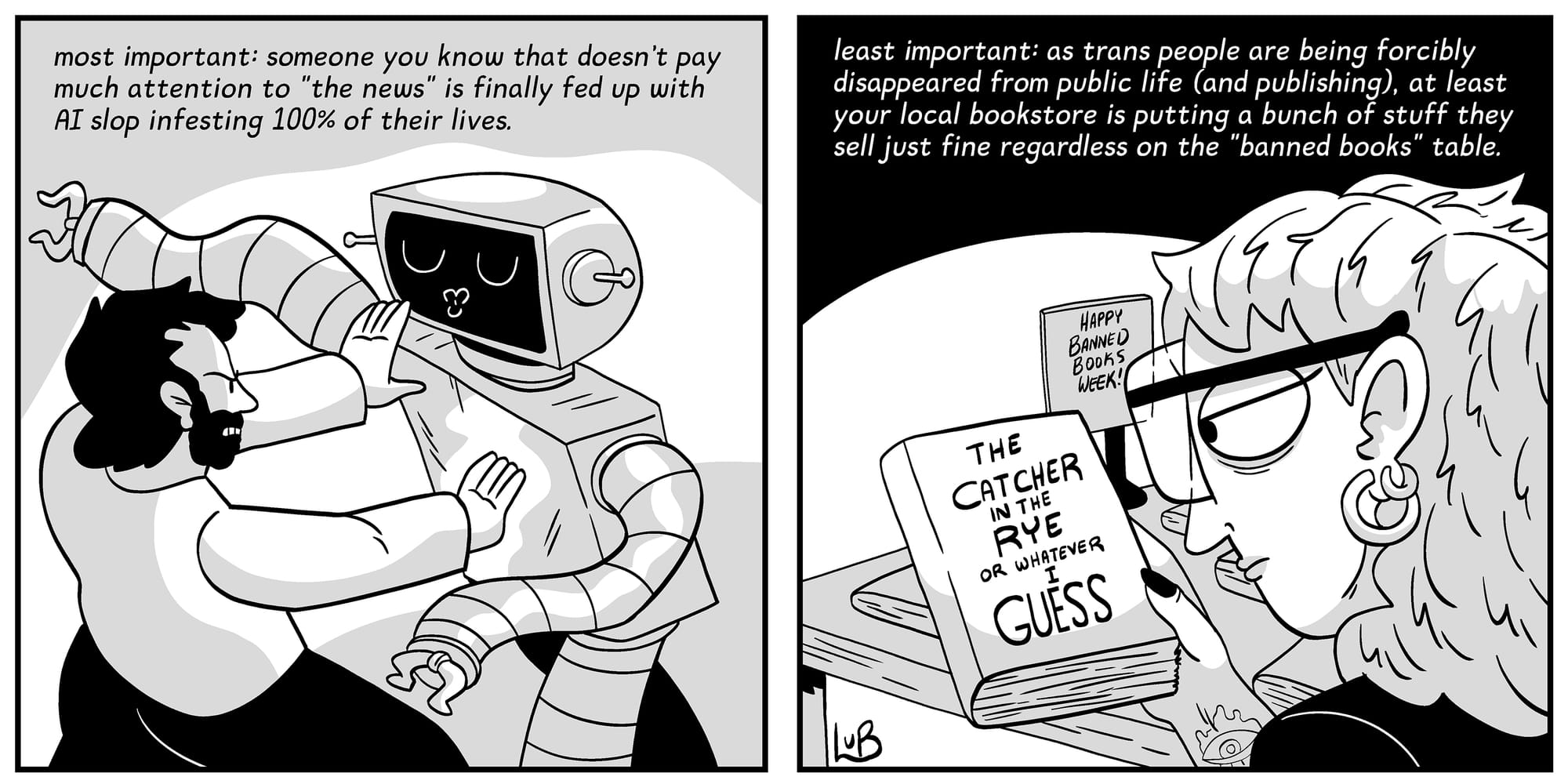
Mattie Lubchansky is a cartoonist and illustrator living in beautiful Queens, NY. Her newest book Simplicity is out now from Pantheon. / mattielubchansky.com, Bluesky
Advait Arun
I can’t totally blame anyone for treating politics like sports betting.
Most important: Speculation has infiltrated my corner of policymaking. Friends working in energy policy now obsessively track the stocks of mining and power companies, hoping to cash out off federal investments or similarly glitzy announcements. The president makes it easy: Not only does his careless policymaking drive the attention economy, but he has even recommended that citizens buy stocks to profit off his actions. So I can’t totally blame anyone for treating politics like sports betting. (I’m not immune, either.) But it’s chilling to watch them refract chaotic policy developments through prisms of personal benefit and the promise of a dopamine hit.
Least important: Both the climate movement and I lost our voices at this year’s New York Climate Week. As I was nonstop popping cough drops, spokespeople across climate institutions made a whole week of throat clearing: They expressed shellshock at the Inflation Reduction Act’s collapse while shoehorning shibboleths like “dominance,” “abundance,” and “affordability” into their messaging. Meanwhile, industry-side talking heads dissembled about the growth potential of their sectors, thanks to the administration and AI. It felt predictable and reactive, a sure sign nobody knows what else to say. With time, with bitter medicine, hopefully the climate movement will find its own voice again.
Advait Arun is an energy finance analyst at the Center for Public Enterprise. He writes about climate, finance, and politics, and edits the Caravanserai magazine for policy and culture. / Substack, Bluesky
Deena Mousa
If you own an index fund, congrats, you’re now betting on AI, whether you wanted to or not.
AI is eating the economy. Computer equipment and software investments accounted for more than 90 percent of US economic growth in the first half of this year. Not 90 percent of tech growth. Ninety percent of everything. Let me say that differently: Without AI spending, the American economy would have grown basically zero percent.
Seven companies—the ones you know, Nvidia and Microsoft and the rest—now make up 37 percent of the S&P 500. All of this is sensitive to accounting choices and market-cap math, but the direction of travel is unmistakable. If you own an index fund, congrats, you’re now betting on AI, whether you wanted to or not.
And yes, it’s probably a bubble. The Shiller P/E ratio is at dot-com peak levels. The financing is wildly circular: Nvidia invests in OpenAI which buys Nvidia chips which... you get the idea. Pre-revenue companies are raising billions despite literally refusing to explain what they’re building. When this corrects, it’s going to hurt. Your 401(k) takes a hit, some regions face recession, service jobs disappear when wealthy households pull back spending. That’s real pain for real people.
But that’s less catastrophic than it seems. There’s $3 billion worth of construction happening every month in the form of things like data centers, power plants, and grid upgrades. That doesn’t disappear when the bubble pops. The dot-com crash left us with “overbuilt” fiber-optic cables that became the backbone for streaming video. The railroad bubble left us with, well, railroads.
Bubbles are often how America builds things it needs but can’t justify through normal channels. We might be getting a massive infrastructure upgrade disguised as financial speculation. That’s a complicated trade-off, but probably not the “shoveling money into nothing” people picture when they hear “bubble.”
Deena Mousa is a researcher, grantmaker, and journalist. You can read more of her work at newsletter.deenamousa.com. / Bluesky, X
Ryan Broderick
This year proved that if you aren’t on camera now, you basically don’t exist.
Most important: It’s video. Specifically short-form social video, though, long-form social video is really moving culture right now too. No matter the length, this really felt like the year the web flipped over from a thing you read to a thing you watch. And this is causing all kinds of problems—misinfo, fascism, Labubu dolls, etc. And it’s also revealing some weird insights. Last year, I wrote that TikTok didn’t matter anymore. And I think I was right! Whether it’s because the app is throttling itself to dodge the ire of the Trump administration or it just no longer has the same monopoly on young people it once did, it isn’t the center of culture it used to be. But it did create an internet where everything basically feels like TikTok. Is this permanent? Who knows. Typically not, but Silicon Valley has sort of lost the plot and even the new AI products we’re seeing are just TikTok again. But this year proved that if you aren’t on camera now, you basically don’t exist. Adjust accordingly.
Least important: This one is looking ahead a bit because I don’t think we’ll know the results for a little while, but I think it’s celebrities and your proximity to them. There are a whole lot of creators (and politicians) that have basically built sizable “careers” this year out of their relationship, real or perceived, to someone who is already famous. Some of these people have podcasts, some of these people have TV shows, some of these people are running for office. All of them made a very Trumpian bet on the idea that fame was transferrable. We went through this in 2016 too, but no one remembers anything anymore. It didn’t work then either and I think we’re already seeing the cracks in this again. Popping up in Charli XCX’s TikTok videos will not help you, standing next to Rep. Alexandria Ocasio-Cortez or New York Mayor-elect Zohran Mamdani won’t either, nor will writing a tell-all memoir about your affair with a powerful politician. Won’t help you build anything that lasts anyways. Now is the time to make stuff, not stand next to someone. And, yeah, as I said above, probably get comfortable being on camera.
Ryan Broderick writes the Garbage Day newsletter and hosts the Panic World podcast and writes about internet culture and technology. / Bluesky, X
Dave Levitan
The body count from USAID’s destruction alone is at least in the hundreds of thousands already.
Most important: When Elon Musk’s DOGE minions somehow managed to rampage their way through much of the federal government, the immediate and lasting impacts were devastating. The body count from USAID’s destruction alone is at least in the hundreds of thousands already, with knock-on effects that will take years to cascade outward and likely even longer to offer up a full accounting. This counts as “most important” foremost because of those lives destroyed in one way or another, actual people that Musk’s addled melon cannot conceive of as real in a way that seems to have seeped outward, slime mold-like, into the various other Big Balls-esque brains who brought the poisoned internet memescape into the real world. But also because DOGE’s infiltration of not just USAID but basically all of it functions as the apotheosis of a revelation specific to the Trump era: that none of the institutions we took for granted can stand up to some extremely aggressive liars willing to bang on locked doors and shout, figuratively and literally, without a shred of reticence or uncertainty or really any emotion beyond destructive glee, that they must be allowed to enter and rip whatever out of the walls they decide needs ripping. It barely matters that they are already more or less gone; they claimed domain after domain, and what we had built over centuries didn’t know how not to give it to them.
Least important: Centrist pundits—really the same maybe 10 or 12 of them, again and again—insisting the same things they have always insisted, even in the face of galloping evidence to the contrary, not to mention the most glaringly obvious moral counterarguments the world has offered in decades. They’re important in the sense that we all must apparently keep reading and listening to these takes, over and over, and those pundits must keep getting richer and richer while every other writer scrapes out a living in an increasingly hostile hellscape; but from the long view, the view from the end, they will have nattered and squawked from the wrong side of history for, essentially, nothing.
Dave Levitan is a science journalist who writes Gravity Is Gone and has bylines all over the place. / davelevitan.com, Bluesky
Tim Hirschel-Burns
It is a reminder of how many people in the world live perilously close to the edge.
Most important: The destruction of USAID. It mattered democratically, revealing that our institutions were so fragile that all it took to blow up a Congressionally established agency was two weeks, the world’s richest man, and a couple of Zoomers with names like Big Balls. It mattered symbolically, proudly declaring that the world’s richest country did not see global solidarity as worth even one percent of the budget. Most of all, it mattered materially. Some estimates find that it will end up causing an increase in deaths equal to the combined populations of Michigan and Oklahoma. Other estimates suggest those figures are hyperbolic, and it will only be as if all of Oklahoma died. Just since January we have likely lost a full Vermont—that is, if two-thirds of Vermont were children. It is a reminder of how many people in the world live perilously close to the edge, how few ready-made substitutes there are for international aid, and that the great killers are disease and destitution even more than bombs and bullets. The cynics will say that USAID was never more than a band-aid. They would be right. But a world without bandages is a bloody and infected one.
Least important: All the takes from policy wonks who sanewash the Trump administration, convinced that there must be more to their policymaking than Twitter-fueled conspiracy theories and the latest whisper in Trump’s ear.
Tim Hirschel-Burns works at a global development think tank and writes a Substack on global inequality and interconnection. / Bluesky, X
Doug Mack
I’ve found reassurance and hope in human connections and the number of people just showing up for each other.
Most important: People working to create and support community. In a time when fascists and Al cultists are taking a sledgehammer to our basic institutions and social structures, I’ve found reassurance and hope in human connections and the number of people just showing up for each other. The protesters in the streets; the groups of strangers blowing whistles and rushing to the scene when ICE shows up; the hundreds of people who turned up to a recent upstander training session at a church in my South Minneapolis neighborhood. On a more joyful, personal front, I’ve recently rediscovered the delight of meeting up with people you don’t know that well. Cheeseburgers with acquaintances from social media; a long, cocktail-fueled lunch with other parents from my kids’ school—an informal hangout is restorative and grounding, something I had somehow forgotten in the slog of middle age and the chaos of the cultural moment. A better world is made of many parts, large and small, but the important thing is that we build it together.
Least important: The haters.
Doug Mack is the author of The Not-Quite States of America: Dispatches From the Territories and Other Far-Flung Outposts of the USA (W.W. Norton) and runs the food history newsletter Snack Stack. / Bluesky
Brooke Borel
The slash-and-burn approach of the Trump administration has been so disruptive that it’s hard to fathom how we’ll end up on the other side.
Most important: The ongoing dismantlement of American scientific and medical research as we know it. Look, there are longstanding, valid critiques of federal agencies like the National Institutes of Health. But the slash-and-burn approach of the Trump administration has been so disruptive that it’s hard to fathom how we’ll end up on the other side. The NIH has lost thousands of employees, paused or terminated thousands of grants, and if the current 2026 budget is approved the agency’s budget will shrink by 40 percent next year. This means less money for crucial research related to everything from infectious diseases to cancer to vaccines. At this rate, are we really going to Make America Healthy Again?
Least important: 6-7. Please make it stop.
Brooke Borel is the articles editor at Undark magazine. / brookeborel.com, Bluesky
Olivia Messer
Journalists can never quite get our feet under us before another wave hits.
Most important: The American descent into fascism, as political experts and historians have been ringing the alarm about, strikes me as the most glaring. Watching press and academic freedoms erode, illegal and inhumane detentions by ICE of everyone from disabled children to US citizens, corruption in both federal and state governments, legacy media outlets willingly capitulating to financial and coverage-related intimidation, the criminal persecution of the president’s enemies, and bloody displays of political violence have all shaken me. President Trump’s second term has created a deeply chaotic news environment in which journalists can never quite get our feet under us before another wave hits. In some ways it’s been like walking through mud for my team at The Barbed Wire, but it feels more important than ever.
Least important: I bought a large three-wick candle from Nest, and it melted in transit. I had to mutilate it in order to light it, wasting a ton of expensive wax. It was annoying, but it didn’t matter at all :)
Olivia Messer is editor-in-chief of The Barbed Wire and a champion reality-TV-binge-watcher. / Bluesky, X
Pete Davis
The campaign was powered by an embodied, local patriotism.
Most important: Zohran’s mayoral campaign was one of the healthiest things to happen in American civic life in years. Almost every aspect of it was a direct counter to the major civic ills of our era. It was relentlessly focused on common material problems spoken about in concrete language—much less “we will secure and defend access to opportunity for all” and much more “we will make the buses fast and free.” Despite all the focus on Zohran’s snazzy social media skills, the heart of the campaign was 50,000 in-person volunteers dedicated to engaging their neighbors in serious conversations about the future of their shared city. And most importantly, the campaign was powered by an embodied, local patriotism—of city pride and love of neighbor—rather than the imperial, saber-rattling faux “patriotism” that has been misleading us for a quarter century.
When I was growing up, the north star of most young politicos was The West Wing. If, following Zohran’s example, a larger share of the next generation channels their civic focus, ambition, and creativity into their mayor’s office (or, even better, their neighborhood organization), we will be a healthier country.
Least important: For another year, leaders of the supposedly “populist right” continued to earn headlines for their rhetoric about breaking with Republican orthodoxy on corporate power, labor rights, etc. But for all the heterodox talk from folks like JD Vance and Josh Hawley about this break, how much change have we seen? Why is the federal minimum wage still $7.25? What is their plan for increasing union density? Why are they defunding the worker and consumer protection police? Until they do something important rather than just say something important, it’s reasonable to think this is a classic case of: Meet the new boss, same as the old boss.
Pete Davis is a writer and civic advocate in Baltimore. / petedavis.org, X
Margaret Howie
We are all so tired, and you can sense it through this nagging, dullened internet.
Most important: The internet became cringe. Filled with AI slop and disinfo, run by sociopathic technocrat dweebs, humanity’s digital id has had its impulses deadened. We are all so tired, and you can sense it through this nagging, dullened internet, just sitting there like an annoyed uncle in your living room waiting for you to laugh at his racist jokes. Maybe everyone is doing what I’m doing—online for newsletters, lofi chill mixes, and craft tutorials, while ignoring as much of the rest of it as I can.
Least important: The moral panic over Labubus. You’re not convincing me to see anything beyond the usual daytime levels of dystopia in this generation’s Troll dolls.
Margaret Howie is an editor at Space Fruit Press and teaches at Illume Pilates in beautiful South East London.
Nicholas Jackson
Personal superintelligence and whatever comes next will receive the same breathless coverage.
Most important: This year reminded us that tech futurism is great theater and lousy prophecy even as leadership continued issuing grand predictions about the next frontier. Meta, which infamously changed its name to signal a multibillion-dollar bet on the metaverse, is pivoting again after burning through huge sums with little adoption to show for it. Personal superintelligence and whatever comes next will receive the same breathless coverage. But these pronouncements are often little more than corporate positioning dressed up as revelation. This should be the least important, but until we realize CEOs are selling futures, not seeing them, we’ll keep diverting talent, capital, and political attention toward fantasies while the systems that actually govern our lives—housing, transportation, public health, education—atrophy.
Least important: The snake plants I’ve taken for granted started to give up on me. I brought them in during COVID and, because they’re supposedly indestructible, my attention drifted elsewhere—the bamboo palm reaching for the ceiling, the sensitive little guy that’s been exiled to a windowless bathroom. This year, they stopped thriving. Not dramatically, just enough to signal that even dependable things have their limits. One weekend of care—sunlight, some water, a little time—brought them back. It was embarrassingly simple. So that’s the lesson: Resilience isn’t a free resource. The foundations still need tending to. And when they get it, they recover quickly, often faster than we expect ourselves to.
Nicholas Jackson is trying to figure out how to keep working ethically in media, publishing, and tech in 2026 and beyond; he’s previously led Atlas Obscura, Pacific Standard, and SSIR. / nbjackson.com
Niko Stratis
This year has largely been total shit, but community has saved it time, and again and delivered us to the end.
Most important: In my desperate search for the silver lining in a year blotted by dark clouds, what I find myself returning to is a simple idea. That, while none of our pillars are here to support us, community will build walls all the same. We are here for and with each other, and only in standing in solidarity will we survive. This year has largely been total shit, but community has saved it time, and again and delivered us to the end. The next year will open again, and community will gather there too, fighting and laughing and building structures that money and power could never imagine.
Least important: Never has a shiny new toy so thoroughly shown its ass than AI did this year. If this tech was actually going to fundamentally change our lives it would be less terrible. It can’t even search my email properly, it makes terrible, forgettable art that is widely rejected by anyone who sees it. The bubble is inching ever closer to an eager pin, sharp and ready. A hell of a year for the failed notions of out-of-touch tech dorks who think we want this shit.
Niko Stratis is a writer and former smoker who lives in Toronto. Her debut book is titled The Dad Rock That Made Me a Woman. / nikostratis.com
David Covucci
Young journalists have a new home to get the same kind of recognition and eyeballs as old Twitter.
Most important (I assume this is about media, otherwise it would be the vacuum sealer I purchased) was the solidification of Bluesky as platform for building an audience. Say what you want about old Twitter, but it was an invaluable resource for getting noticed at the start of a career. I used to run an internship at my old job and I’d always tell students that regardless of their thoughts about it, they should be on Twitter. But from 2022 onward, I would kind of just shrug about what channels to use at the onset of a journalism career. The ownership, the algorithm, it was all janked up. I didn’t have great advice for where to get noticed by editors and people in charge at outlets you want to work for. But with Bluesky, I do think young journalists have a new home to get the same kind of recognition and eyeballs as old Twitter. Sure, there were problems with that system, but so many people got their start that way. So I’m hopeful it becomes a new pipeline and launches the next decade of media careers.
Second was Milo Yiannopoulos outing Benny Johnson. Just in terms of sheer joy I received from that clip.
Least important: Well, sticking with the social media theme, is anything that happened on Threads.
David Covucci is the editor-in-chief of FOIAball, which covers college football through public records reporting. / Bluesky, X
Daniel Whiteson
We invested zillions of dollars in data centers lured by the hype that chatbots will replace scientists and cure cancer.
Most important: The most important thing that happened this year was something that didn’t happen. We failed to sustain our investment in ourselves, in our future, in our children, by failing to fund basic scientific research. Cuts in support for math, physics, and beyond show a lack of understanding that our entire way and quality of life is due to earlier investments.
Least important: The least important thing to happen this year was something that shouldn’t have happened. We invested zillions of dollars in data centers lured by the hype that chatbots will replace scientists and cure cancer. If we want to accelerate science or cures, we should spend those dollars on science and medicine, not chatbots.
Daniel Whiteson is a particle physicist. He teaches at UC Irvine. / sites.uci.edu/daniel/, Bluesky, X
Rax King
You couldn’t ask for a better visual representation of the goons’ real-world impotence.
Most important: A guy in my hometown of Washington, DC, hucked a Subway sandwich at a US Customs and Border Patrol agent at point-blank range and ran away. I won’t name Sandwich Guy here—the sandwich-hucking may have been beautiful and meaningful to me, but he should have the chance to move on with his life now that he’s been acquitted of assaulting a federal officer by a jury of his peers. But the visuals of the incident were just so pleasing, man. This preppy-looking beanpole in his pastel pink shirt, jeering in those big beefy agents’ faces. The sandwich falling apart on contact. Best of all, the slow and easy pace at which Sandwich Guy jogged away from the agents who appeared to be chasing him as fast as they could. He was surrounded by every kind of cop in the moment, and they still didn’t manage to arrest him until a few days later. You couldn’t ask for a better visual representation of the goons’ real-world impotence, despite the fact that they have all the money and power backing their side. The sandwich-hucking wasn’t Most Important because it was the most impactful, but because it offers such sweet hope: We may not have much going for us, but see what humiliations we can impose on the enemy using only a Subway sandwich and a little chutzpah!
Least important: Charlie Kirk’s death. Boy, they really made a big obnoxious deal of it in the days after it happened, didn’t they? Fired all those people for “disrespecting” him and such. But at this stage, the killing of their dearly departed martyr has been reduced to some AI-generated kitsch and a booth for influencers to take selfies in. Well, I don’t have a job to get fired from, on top of which the right seems to have stopped caring anyway, so I’ll say it: Rest in piss, Charlie Kirk. Couldn’t’ve happened to a bigger asshole.
Rax King is the author of the essay collections Tacky and Sloppy, as well as co-host of the podcast Low Culture Boil. / raxkingisdead.com, Bluesky
Ted Scheinman
The death-worship thing—it’s never been for me.
Most important: I shall acknowledge my biases freely: I am weak enough to admit that I love life. I love life so immoderately, in fact, that I would encourage it among all people. It is a related foible of mine to frown mightily at any political program devoted to wanton death.
In 2025, then, the acceleration of eugenics at home and abroad has put me…a little uptight. The death-worship thing—it’s never been for me.
That worship thrives in the current administration. At home, they are sedulously preparing to bring back measles, mumps, smallpox; polio, too, if they can manage it. RFK Jr. is keen to ensure that every child can perform the St. Vitus Dance at least serviceably. But the administration is also killing cancer and vaccine funding, and cutting Medicaid and ACA subsidies, not to mention drinking-water protections and public health, generally. Abroad, the admin has shut down USAID and appears to be making a targeted effort to bring back AIDS in Africa, and so on.
No abatement seems likely. For one thing, never before in modern history has the American media been so transparently captive to the White House. Scott Jennings will appear nightly on Paramount-Skydance-Warner-KableTown to reassure viewers that civilization is in good hands because after all brutality in a suit and an easy manner is the most civilized thing of all. Further: La vida es sueño, death is just the beginning, all that jazz. It’s amazing how philosophical one can be about the deaths of others.
Least important: I leveled up on jazz piano.
Ted Scheinman is the author of Camp Austen: My Life as an Accidental Jane Austen Superfan (FSG Originals, 2018). His next book, Jolt, about electroconvulsive therapy, will be published by Scribner in August. / Bluesky
Susannah Breslin
I was happy, and I was not alone.
Most important: I, like many others, experienced 2025 as if one had been thrown into a burning dumpster. Therefore, it seemed the most radical act one could undertake was to seek out joy. Unexpectedly, I found it in a strip club in New Orleans. It was in the early morning hours, I was inebriated, and I did have a wallet full of cash. But for one brief moment in time, as the women swirled, the spectators gazed slack-jawed at the spectacle, and a young nerd stood up and made it rain dollar bills, I was happy, and I was not alone.
Least important: A few months ago, I was feeling low, so I searched the internet for something that might uplift me. I came across this quote: “To have deep faith is to believe in the extraordinary.” I wrote that line on a neon green Post-it and stuck it to my computer. Occasionally, I notice the Post-it is attempting to peel itself off the computer, as if it wants to escape. Instead, I press the paper’s sticky back against the metal. This may be my version of counting rosary beads. If I do it enough times, my dreams will come true.
Susannah Breslin is a freelance journalist and the author of Data Baby: My Life in a Psychological Experiment. / susannahbreslin.com, X
Tiana Reid
I wonder if we should take more responsibility for our own little problems.
Most important: Genocide, still.
Least important: Whatever it was, wouldn’t it be so insignificant that I wouldn’t even remember it? Something like: a forgettable face, the same old headache, scrolling through my phone. I mean, my first thought was that 30 minutes ago I started crying in the Montreal airport because I couldn’t find a car to take me on a 90-minute ride. I was tired, I was hungry, I had a headache, and I also felt as I did as a child: a baby that had fucked everything up. “First world problems,” I hear people say on loop. In a universe of both the illusion of choice and the possibility of revolution, I wonder if we should take more responsibility for our own little problems, collectively produced as they are by the rotting imperial core and the international elite. All that to say, in my twenties my watchword was “nothing even matters” à la Lauryn Hill and D’Angelo (RIP) and now, well into my thirties, I can resolutely say that everything does.
Tiana Reid is a writer and professor from Toronto. / tianareid.com, Bluesky