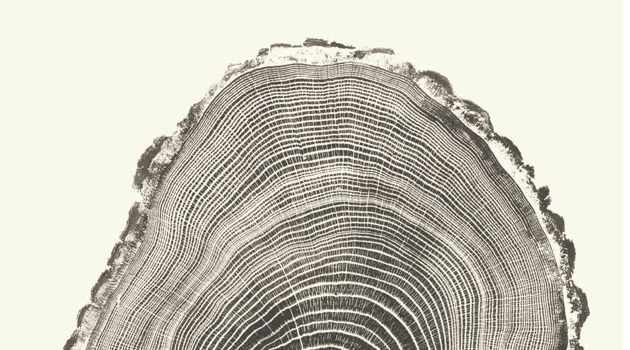
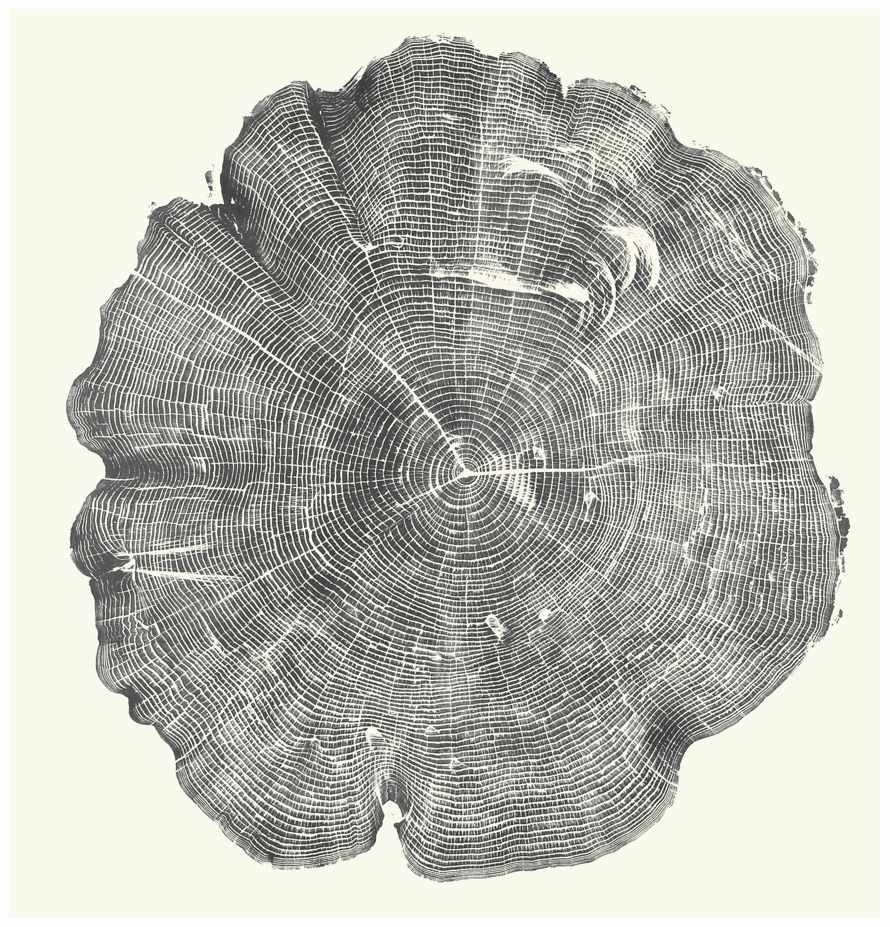
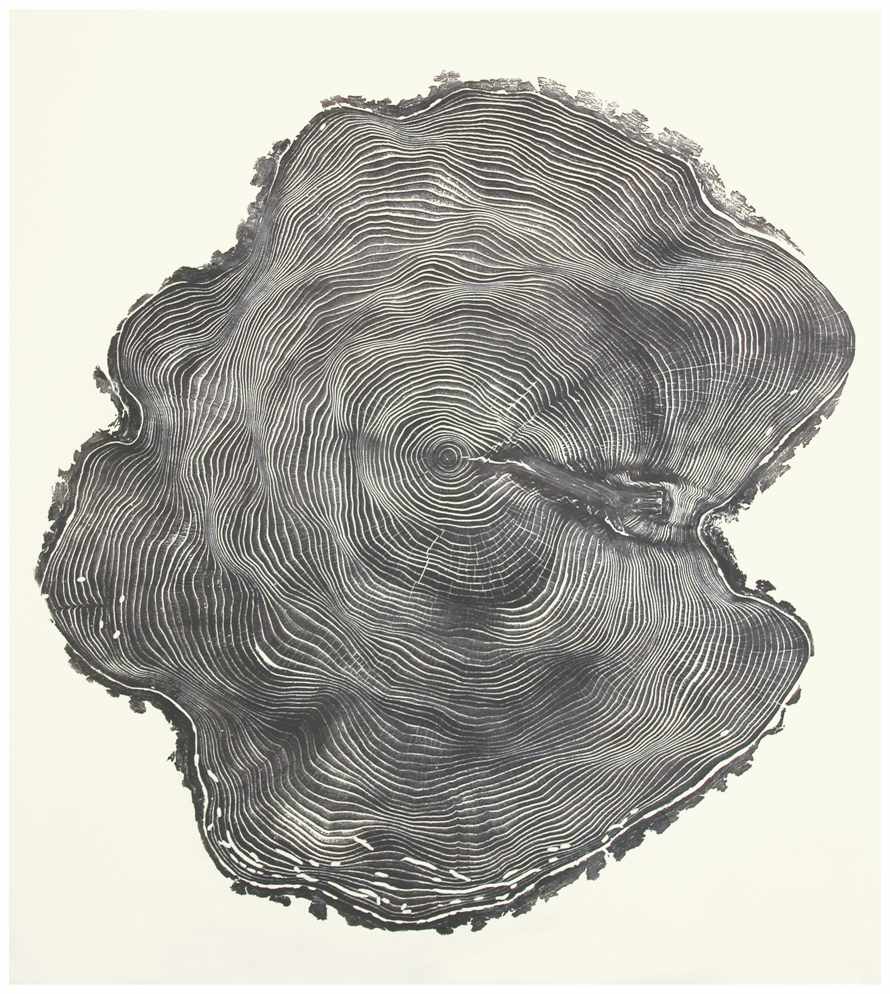
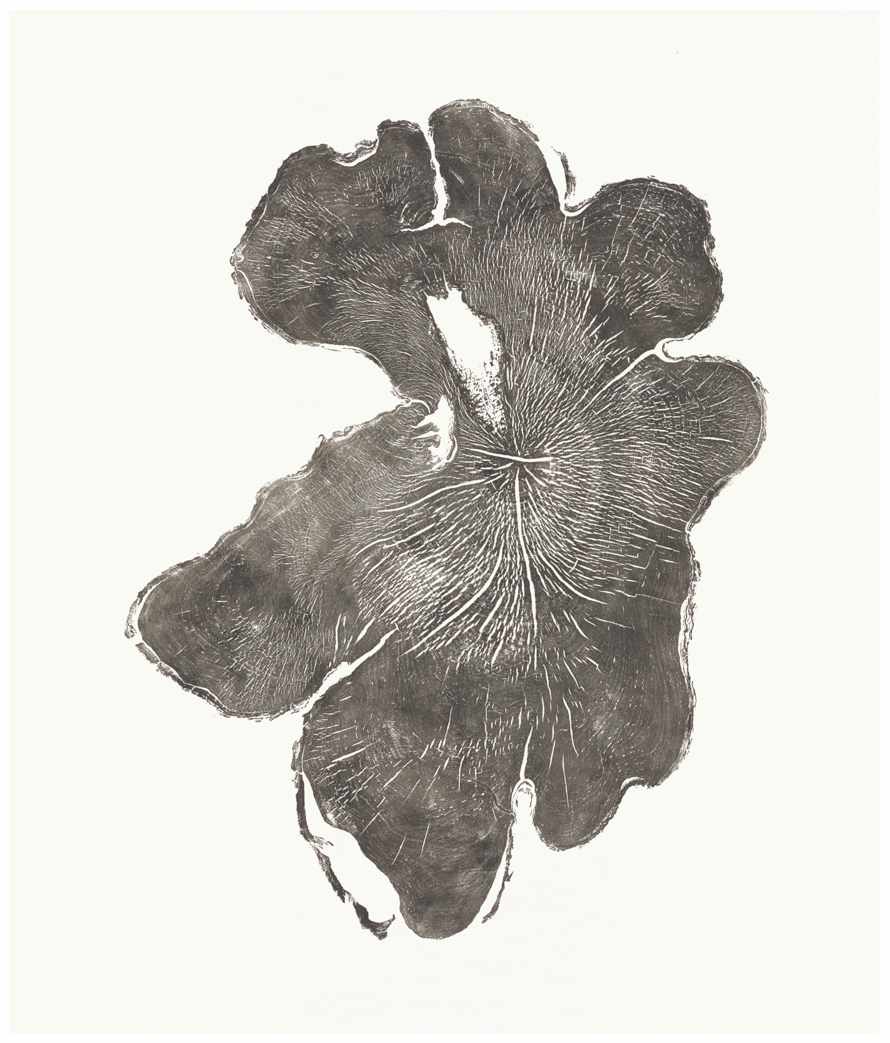
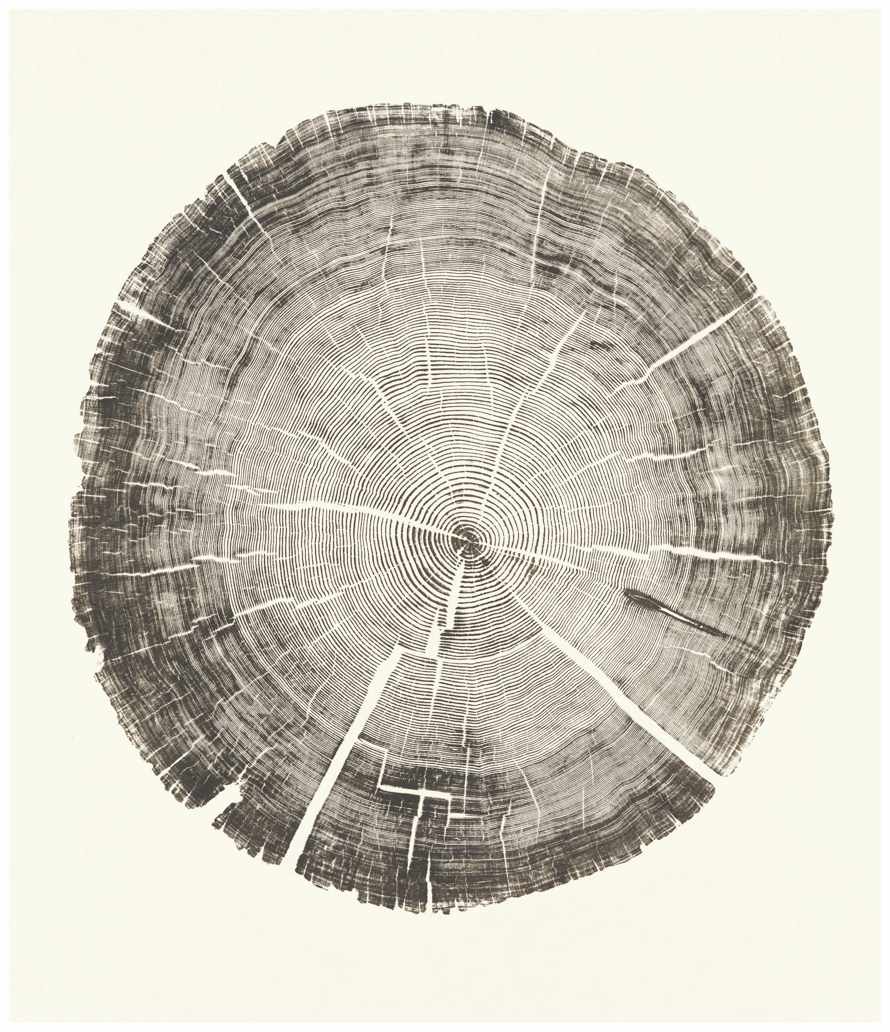
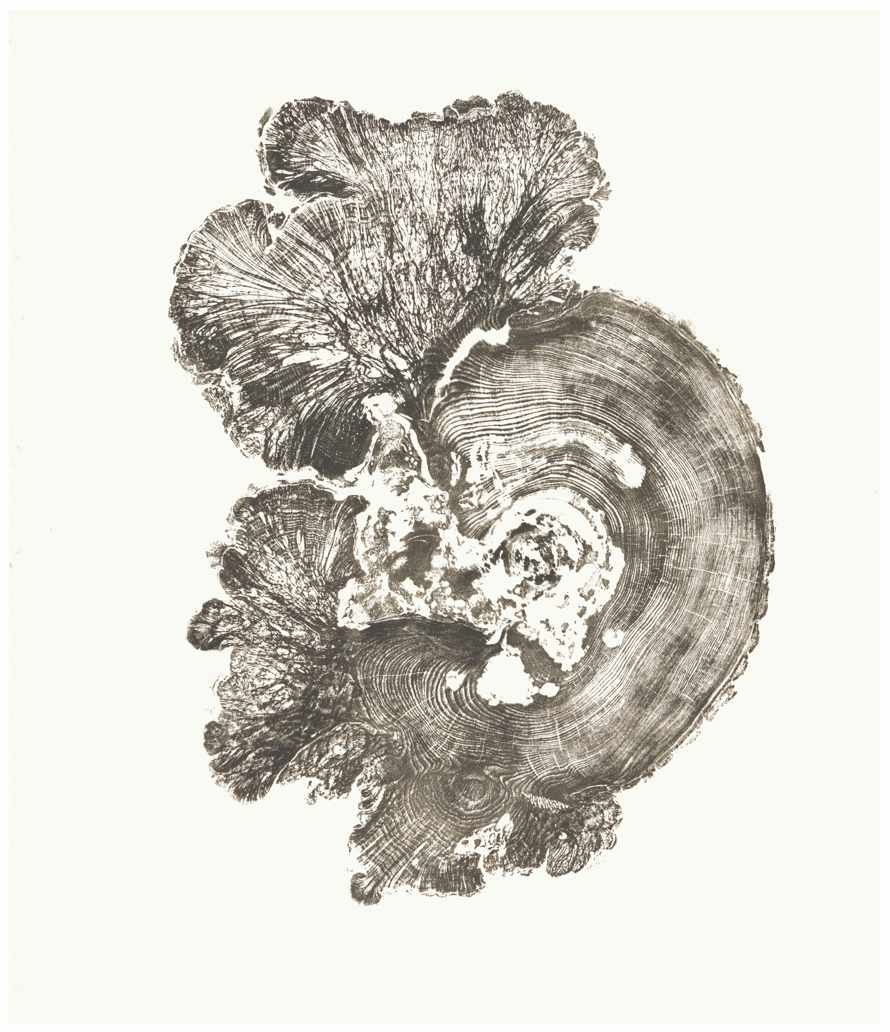
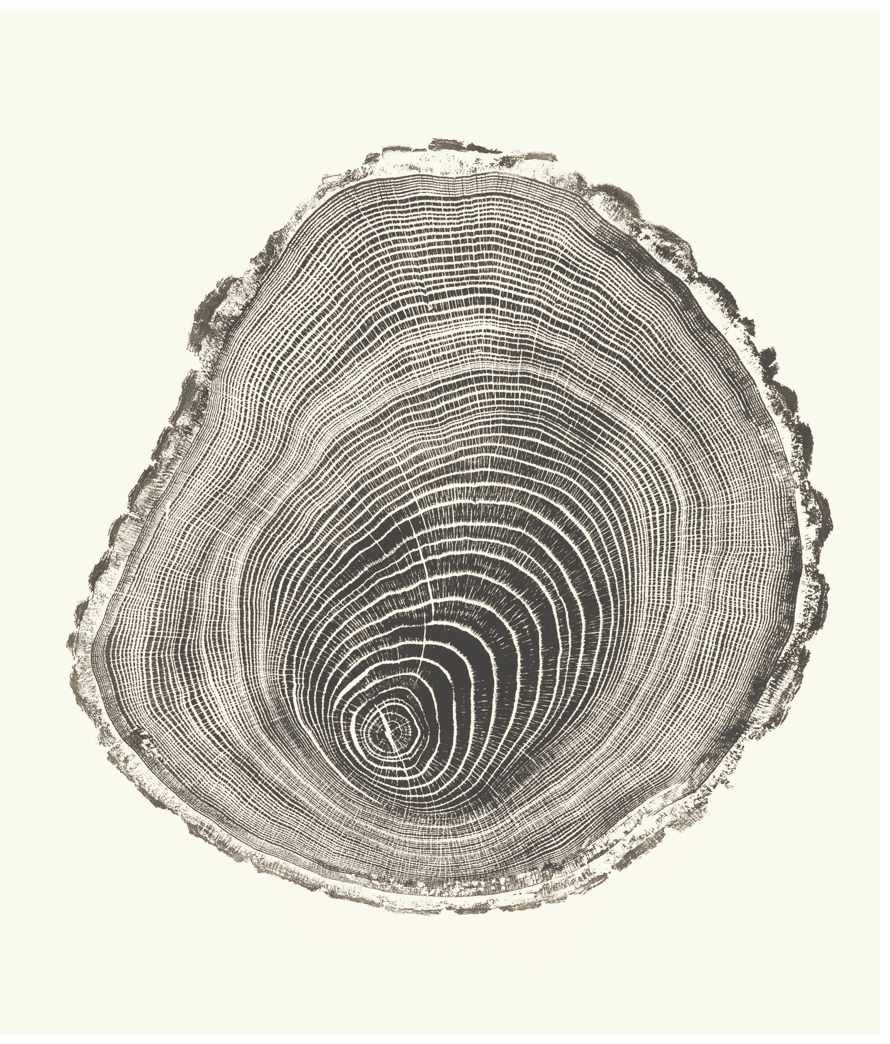
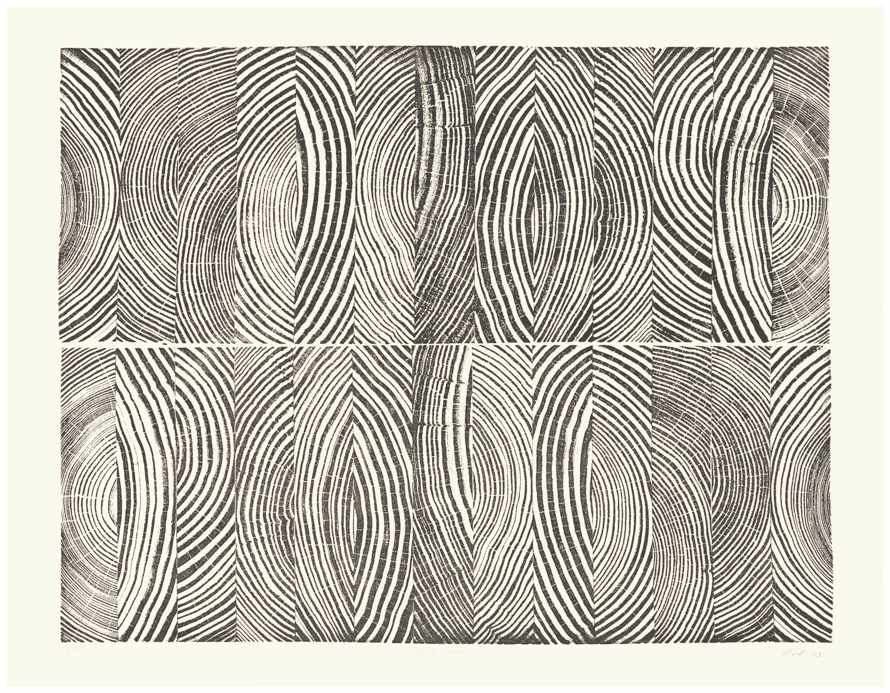
Ash, 2003, 82 years printed. “This was the first relief print I created from a tree cut. When I pulled the print, I was surprised and inspired by how well the details of the block transferred to the paper. The outline is sharp and the growth rings are discrete. Also present are checks, or cracks, from the curing of the block and several marks from cutting and sanding the surface (evident in the top center of the print).”Hemlock 82, 2008, 82 years printed. “This trunk was found at a pig farm in Barkhamsted, Conn. I was immediately drawn to the strong pattern of the wavy rings (the result of irregularities in the growth of the bole). In the print, a cut branch creates a prominent form that extends from the center to the right edge, and various insect holes dot the lower perimeter of the block.”Maple, 2009, 79 years printed. “As I was preparing firewood for the winter, I noticed the undulating outer edge of this maple specimen. Maples generally grow straight and tall in the thick woods; however, at ground level, some take on a naturally curvy shape. Lacking visible growth rings (typical of hard maple wood), the perimeter is imperative to the success of the print. The block also features marks of peeling bark and rot, seen in the white shapes just off center.”Cedar Pole, 2011, 200+ years printed. “An arborist friend brought me this cut telephone pole. We were intrigued by the extremely tight growth rings. From start to finish, it was very challenging to print this piece. Every step—from raising the grain to applying the ink to pressing and printing the contours—had to be meticulous in order to clearly read each ring.”Cedar Burl, 2011. “This is the first burl that I successfully printed. The juxtaposition of geometric and irregular shapes creates a compelling composition. In the cross section, the intricate dendrite forms of the growth are revealed. Also evident is the deterioration of annual rings as the burl spreads and pushes out of the bole.”Compression Wood, 2011, 76 years printed. “The term compression wood describes trees that grow abnormally in the forest. This growth may result from heavy snow or uprooting, or simply from the tree reaching for sunlight. The seashell-like pattern of this block implies that the tree was bending in the direction of the top of the print.”Glue Lam, 2003. “This was one of the first prints I created from dimensional lumber. Glued laminated timber (a highly engineered material in which layers of timber are bonded together) is known for its superior structural strength and used as columns or beams. This print, made from two boards stacked and rotated, showcases the grain patterns of the glued lumber.”
Interview continued
TMN: What’s your daily schedule like?
Bryan Nash Gill: Coffee. Studio along with family and household responsibilities. Cocktail. Dinner. Studio. Bed.
TMN: What is your favorite object made out of plastic?
Bryan Nash Gill: A toothbrush.
TMN: What artists do you like at the moment?
Bryan Nash Gill: Anna Hepler and Edward Villiers.
TMN: What is your favorite smell?
Bryan Nash Gill: Peonies.
TMN: What’s your professional opinion of IKEA furniture?
Bryan Nash Gill: None.
TMN: What is the most rewarding step of creating these prints?
Bryan Nash Gill: Revealing the true nature, growth patterns, and uniqueness of the wood onto paper.
TMN: When are you satisfied with a print?
Bryan Nash Gill: When the print sings.
TMN: Are you a morning person? A night person?
Bryan Nash Gill: Both.
TMN: What’s the highest you’ve climbed in a tree?
Bryan Nash Gill: I’m afraid of heights.
TMN: As a student, were you better in biology or art?
Bryan Nash Gill: Art.
TMN: Coffee or tea?
Bryan Nash Gill: Coffee.
TMN: Where haven’t you been but would most like to visit?
Bryan Nash Gill: Disneyland with my six-year-old son.