
Best Thought, Worst Thought
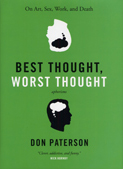
Given the titans residing in the pantheon of aphorists—Oscar Wilde, Karl Kraus, G.K. Chesterton, Ludwig Wittgenstein, Dorothy Parker, Mark Twain, Ambrose Bierce—it takes a writer of high self-regard or no sense of history to attempt a book of aphorisms. Or like poet, editor, musician, and Scotsman Don Paterson, who brings us Best Thought, Worst Thought: On Art, Sex, Work, and Death (Graywolf Press), someone who does not take the task all that seriously:
The shorter the form, the greater our expectation of its significance—and the greater its capacity for disappointing us. A book of aphorisms is a lexicon of disappointments. The form’s only virtue is its brevity; at least the reader cannot seriously hold that it has wasted their time.
Or:
briefcompletemonumental
Then there is this:
left time
Or:
I have no more ambition for this book than that some day someone will be lying in bed and read out a single line—and that their companion will turn away from them in silence . . .