
Book Digest: March 17, 2008
Ex-Chicagoan, Syracuse University mentor, dog lover, and spirited writer George Saunders responds to our query regarding the state of his reading:
Dead Souls
Having participated in a web-based roundtable discussion on Nicholson Baker’s Human Smoke (soon to be posted) and having seen a trio of reviews, the most ludicrous of which characterized the book as “dangerous,” I am looking forward to more, uh, elucidation. Stay tuned.
Chasing the Flame: Sergio Vieira de Mello and the Fight to Save the World by Samantha Power
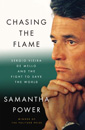
Power crashed into recent headlines based on her intemperate (for a campaign advisor) remarks regarding Sen. Clinton. No doubt this raises Power’s name recognition more than the Pulitzer Prize that she garnered for her remarkable book, A Problem From Hell: America and the Age of Genocide. And certainly more than writing about United Nations officials like Sergio Vieira de Mello, who was involved in global flashpoints like Cambodia, East Timor, Lebanon, and so on until he was killed in a suicide bombing at the U.N. offices in Iraq in 2003. Power uses de Mello’s humanitarian activities as an effective lens through which to assess the international apparatus and responses to peacekeeping and life-saving imperatives. Not the least point of Power’s tome is the extraordinary individual her subject was.
God’s Middle Finger: Into the Lawless Heart of the Sierra Madre by Richard Grant
“I started going to the Sierra Madre out of curiosity,” Grant says. “I soon found out that it was a lot more dangerous than I bargained for, but I kept going back.” For nearly two decades he focused his attentions on the Sierra Madre mountains, which, just a few miles from the Arizona border, run 900 miles south into the heart of Mexico. That area is a habitat for diverse flora and fauna, including bandits, drug smugglers, Mormons, Tarahumara Indians, opium farmers, cowboys, and a mélange of oddball characters. As one of the world’s most productive drug-producing regions, it’s also rife with dangers. Grant writes about it with aplomb and understatement and Jim Harrison, who has a casita on the Arizona side of the border, commends this book’s vivid accuracy and drama.
» Read an excerpt from God’s Middle Finger
Bill Mauldin: A Life Up Front by Todd DePastino
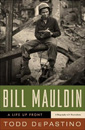
Mauldin, an infantry sergeant during World War II, regularly supplied the Army weekly Stars and Stripes with his cartoons of GIs Willie and Joe up at the front. Winning two Pulitzers and continuing his career after the war as a political cartoonist, he famously penned the image of the statue of Abraham Lincoln at the Lincoln Memorial, his head in his hands, crying, following the assassination of J.F.K. DePastino’s biography of Mauldin includes 90 cartoons; he’s also editing a forthcoming two-volume set that will include the entirety of the Willie and Joe cartoons.
» Read an excerpt from Bill Mauldin: A Life Up Front
Fidel Castro: My Life, A Spoken Autobiography by Ignacio Ramonet
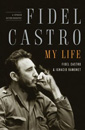
Fidel needs no introduction—though I doubt many of the people who have an opinion know much about him or Cuban history. Tad Szluc’s authoritative critical biography should serve as a counterpoint to these 700 pages of self-serving testimony by Castro that Spanish journalist Ramonet gleaned from over 100 hours of conversation.
Bananas! How the United Fruit Company Shaped the World by Peter Chapman
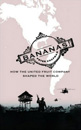
Chapman writes a revisionist history of the greedy, evil multinational corporation previously covered by Tom McCann’s well-regarded memoir/case study Company and Steve Schlesinger and Stephen Kinzer’s Bitter Fruit, which charts the rapacious company’s involvement in the 1954 C.I.A.-sponsored coup of Guatemala’s democratically elected government.
Our Story Begins by Tobias Wolff
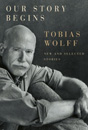
Longtime Syracuse University mentor (now at Stanford) and master of short-form fiction Wolff anthologizes 31 stories, including 21 previously published—but, as Wolff explains, tweaked for this volume. He has previously written a pair of memoirs, This Boy’s Life and In Pharaoh’s Army, and most recently a novel, Old School. Of the writers who were students at Syracuse with whom Wolff worked are Jay McInerney, Tom Perrotta, George Saunders, Alice Sebold, and Paul Watkins.
» Read an excerpt from Our Story Begins
The Art of Ill Will: A History of American Political Cartoons by Donald Dewey
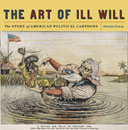
Dewey assembles an authoritative archive of early American cartooning. This tome includes about 200 examples, including famous 19th-century inker Thomas Nast as well as Joseph Keppler, Laura Foster, Theodore Geisel (Dr. Seuss), Bill Mauldin, Jimmy Margulies, Paul Conrad, Gary Trudeau, and others. My all-time favorite is Edward Sorel’s (“I wake up angry and go to sleep angry. Essentially, my cartoons are a kind of therapy to keep myself from going crazy at the insanity and injustice in the world.”) pictorial of evolution using recent U.S. presidents from F.D.R. to Clinton. Great, unforgettable images throughout, and a great history book, also.
Fall of Frost by Brian Hall
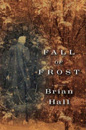
Hall’s last book, I Should Be Extremely Happy in Your Company, vividly recreated the world of celebrated American explorers Lewis and Clark. He now returns to fiction with a novel spotlighting a familiar name: American poet Robert Frost. Frost, who died at the age of 88 in 1962, apparently had a life ravaged by tragedy. His father died when he was 11; his sister was permanently hospitalized; and three of his five children died and one went insane. All grist for the fictional mill and certainly in the hands of an able storyteller like Hall.
The Risk of Infidelity Index by Christopher G. Moore
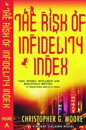
Moore has published the ninth in the low-rent Bangkok P.I. Vincent Calvino series, one that’s receiving enthusiastic notices around the world. In this installment Calvino is led into the deadly sights of a drug ring by the coincidental deaths of a teenage girl and middle-aged lawyer that have dovetailed into his case. As Bangkok is ranked the world’s no. 1 sexual playground, Calvino is charged with investigating the husbands of a group of suspicious wives. What follows may be predictable, but it’s amusing and well-formed.
Shame in the Blood by Tetsuo Miura, translated by Andrew Driver
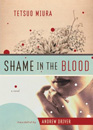
That Miura’s novel sold over a million copies in Japan undoubtedly was the catalyst for its publication in the English-speaking world. Though in fact it is a novel via the device of interconnecting stories out of the nameless narrator’s life, which mirrors the harrowing details of Robert Frost’s. Two sisters commit suicide, two brothers disappear, and his one remaining sister is nearly blind. Michael Ortofer concludes:
Here is a narrator who doesn’t play many games… He draws no pretty pictures, he just tells it like it is. It makes for an often powerful story, as some of the episodes are particularly well related, the understated writing effectively poignant. But there’s a lack of cohesion and continuity… Hardly a happy story—and it doesn’t feel like quite the whole story—but well worthwhile for many of the excellent parts.
The End of the Jews by Adam Mansbach
Mansbach’s (Angry Black White Boy and Shackling Water) third novel seems to tread on familiar Philip Roth terrain: Depression-era Eastern U.S. metropolis spawns Jewish success story and continues with his grandson spinning his own version of the family history. Fellow Jewish scribbler Keith Gessen credits Mansbach with a new twist on the multigenerational Jewish epic: “This is far more tough-minded reading than we are used to on the subject. I don’t love Jews any less for it, and neither does Mansbach, but I do know us better for what we are. This is a heartfelt, truthful book.”
» Read an excerpt from The End of the Jews