
Do We Care What Time It Is?
Perhaps future anthropologists, stirring the entrails of our American civilization, will find it remarkable that in the third millennium of the Christian era, Time magazine placed novelist Jonathan Franzen on its cover. What I find remarkable is that anyone thinks the dying gasps of an endangered media species are news worth noting (unless it was to comment on another fine image by photographer Dan Winter). The Guardian’sfollowup was a bit more expansive, wandering into the terrain of prediction with this lame concluding graf:
Freedom
Yikes!
* * *
For understandable reasons (to me), I had both of Emily St. John Mandel’s novels in hand before I got around to reading her first, Last Night in Montreal (Unbridled Books), which, by the way, has one of the ugliest covers in my considerable memory, though not the one found on her website. A more cautious person might wait to read her second novel, The Singer’s Gun, to shower her with high praise and flaunt my inestimable taste—but hey…
Anyway, the publisher is dead-on in describing this novel as a “story of love, amnesia, compulsive travel, the depths and the limits of family bonds, and the nature of obsession.”
Nineteen-year-old Lilia Albert has been traveling constantly since her father abducted her at the age of seven, and has for some years been pursued by a private detective who abandons his own daughter in this unlikely scenario. Need I say that this is an odd ensemble of characters doing odd things and viewing life from an oblique angle?
* * *

Having these past few years found it noteworthy to heed the publication of English poet Geoffrey Hill’s artistry, I am pleased to once again pass on the news of his latest opus, Selected Poems (Yale University Press), which has the great utility of traversing his 50-year body of work, from his first tome, For theUnfallen, to Without Title. From “Funeral Music”:
* * *
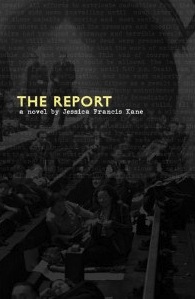
Ah yes, another one of my TMN colleagues, Jessica Francis Kane, has run the publishing gauntlet and is (no doubt) happily watching the laudatory reviews of her first novel, The Report (Graywolf Press) accrue. Additionally, her fine efforts have been rewarded with being short-listed for the Flaherty-Dunnan First Novel Prize with such fine, (mostly) young writers as Maaza Mengiste, Julie Orringer, Karl Marlantes, Adam Ross, Michelle Hoover, and Drew Perry.
Kane’s story draws upon a terrible incident/accident that took place in London’s Bethnal Green tube station during March 1943, killing 173 people. It falls upon magistrate Lawrence Dunne to investigate and report on this tragedy, which he attempts while remaining sensitive to the crosscurrents of concerns of all involved—think 9/11 commission report for a reference point—which my talented comrade presents with alacrity. Which is to say, Ms. Kane can write.
* * *
With The Book of Shells: A Life-Size Guide to Identifying and Classifying Six Hundred Seashells (University of Chicago Press) in hand, I can’t say that I feel bereft that my feet have not trod through the sands of various coastal beaches in the last few years. One takes one’s pleasures where one can. But this visually sumptuous compendium is replete with an information-packed catalogue. Though it must be said I don’t care about the biological minutiae, the pictures compel sufficiently (in 650 pages with about 2,400 color plates.)
* * *
If you pay attention to the dire predictions of various experts, analysts, and doom-sayers—James Howard Kunstler being one, with The Long Emergency and The World Made by Hand—a serious reorientation of social organization will be necessitated by dwindling worldwide oil reserves and other economic disruption.
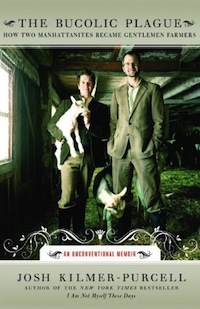
Just the kind of thing dealt with in Josh Kilmer-Purcell’s (I Am Not Myself These Days) The Bucolic Plague: How Two Manhattanites Became Gentlemen Farmers: An Unconventional Memoir (HarperCollins), albeit for personal and non-urgent reasons. Famed chef and social engineer Alice Waters blurbs:
I adore the Beekman boys’ story. Their unlikely story of love, the land, and a herd of goats is hilariously honest. If these two can go from Manhattan to a goat farm in upstate New York, then I can’t help feeling there is hope for us all.
Of course, who could resist a story whose ingredients include an ex-drag queen, a herd of 88 goats, Bubby, the bionic cat, some very musical roosters, and a caretaker named Farmer John?
* * *
One could be justified in asserting value for a cultural/intellectual history spanning from Germany’s Baroque period to the post-Nazi era given the lengthy list of that country’s formidable thinkers and creators. By Hitler’s ascension to power, Germans had won more Nobel Prizes than any other nationals, more than the British and Americans combined. Thus we have Peter Watson’s The German Genius: Europe’s Third Renaissance, the Second Scientific Revolution, and the Twentieth Century. However, including the current pope, Joseph Ratzinger, as an example of the vibrancy of German culture is a bad sign of Watson’s judgment and values. One reviewer astutely opines:
The German Genius
* * *
Well, if nothing else, I would be an admirer of Nicholson Baker (Human Smoke, The Anthologist) based solely on his admirable advocacy of paper and his (possibly) quixotic efforts to save historical newspaper archives.
But there is much more. In a recent New Yorkerarticle, Baker, who is decidedly not a gamer (player of video games), provides a skillful and, more commendably, patient explication of various features of this addictive pastime. He is insightful about specifics of some games and gaming strategies without the predictable cant about the intellectually debilitating effects of video-gaming.
Like Baker, I am not now nor have I ever been interested in this subject, but I certainly know many people (my son among them) who partake. This is a fine example of writing that enlivens a subject about which I was previously uninterested.
* * *
Maybe I ought invent a category (much like Keith Olbermann’s “Worst Person of the Day”) and regularly cite the most useless literary commentary of the week. This week’s includes a so-called literary feature of Tina Brown’s latest enterprise wherein there was some discussion of novellas, which was then picked up by another commentator.
You may find something useful there, and judging from the comments a number of people did, but I find a discussion of novellas without mention of Jim Harrison criminally lacking.
* * *
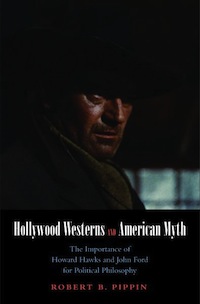
University of Chicago mentor Robert Pippin delivered the Castle Lectures at Yale in 2008, which in essence form his new monograph, Hollywood Westerns and American Myth: The Importance of Howard Hawks and John Ford for Political Philosophy (Yale University Press).
Some readers may find the notion of conjoining film criticism with political philosophy off-putting, for which David Thomson retorts:
Red RiverThe Man Who Shot Liberty ValanceThe Searchers
The fact that David Thomson has written about this book enhances its utility. Consider this probing conclusion:
But here we come to a limitation in this book. Professor Pippin is an academic. As such, he is inclined to assume that the films he discusses have been made for his discussion. But did Hawks and Ford really have him in mind? Did they exercise the lonely rigor with their own stories that one might have expected from Melville or Faulkner? Were they that concentrated or single-minded, or were they presiding over an untidy collective enterprise?
And:
Movies are not novels. They are great public shows. And all these films are more touched by commerce than Pippin ever allows. The legend that Ford preferred, and the dream in which Hawks was immersed, are reflections of a story-telling forever diverted or warped by the business of pictures.
You have to love this guy.