
Ghosts of Chicago
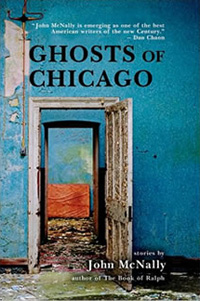
Some years ago in a conversation with the then-ebullient Thisbe Nissen, a recent spawn of the famous (Iowa) Writers’ Workshop, I asked—as I am occasionally prone to do—if there was a writer I should look out for. Her answer was Wake Forest mentor John McNally. McNally (The Book of Ralph), also a graduate of that same writers’ program, hails from Chicago and seemingly benefited from drinking the same waters as the new wave of Chicago writers—George Saunders and Stuart Dybek—for the 17 stories in Ghosts of Chicago (Jefferson Press) are rife with city references, including Walter Payton and William “The Refrigerator” Perry, Frazier Thomas and Garfield Goose, Nelson Algren, the 1968 Democratic Convention police riot, John Belushi, and Richard J. Daly. And what’s more, he shares a sense of humor that for lack of a better descriptor I call the South Side temperament. One of my favorite stories in this assemblage of narratives, “Contributor’s Notes,” explodes the customary short bio found in anthologies to a hilarious 26-page lampoon of an early-career writer’s life:
Zoetrope, McSweeney’sGQnobody
Among the wide swatch of stories McNally plots in Ghosts of Chicago are:
- “Return Policy,” about a man whose wife leaves him after 18 years of marriage, and who resolves to return all their wedding gifts to, of course, odd consequences
- “The Goose,” which dwells on the deeper structures between Garfield Goose and Frazier Thomas, Goose’s puppet sidekick from a ‘50s children’s show in Chicago
- “The End Is Nothing, the Road Is All,” which tells us about Second World War and D-Day/Purple Heart veteran Jimmy, now a down-and-out junkie living in some shrubs (that’s right) on Chicago’s West Side, and who is befriended by Nelson Algren (and Simone de Beauvoir)—and who knows why?
- “Sweetness and the Fridge,” about a road trip with Chicago Bears teammates Payton and Perry
All of which is good evidence McNally will not become the cliché he spoofs in “Contributor’s Note.” More likely, he may succumb to that well-worn literary banality of the gifted writer who is tragically under-read, touted by cranky literary types in the know. In any case, McNally is, in fact, a writer to be read.