
Happiness Is?
The notion of considering the happiness of the citizenry is not a particularly novel one (think Jeremy Bentham), though the burgeoning of happiness research appears to be a growth industry. These days the disaffected white people who are holding various anti-something-or-other rallies around the country seem to elicit at least one description that all observers agree on—these are unhappy people. Which makes happiness information gleaned from ongoing research slightly more urgent.
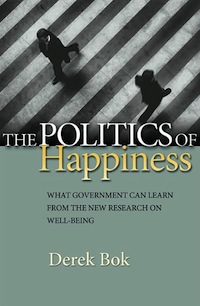
Assuming that numerous studies are not junk social science, in The Politics of Happiness: What Government Can Learn from the New Research on Well-Being (Princeton University Press), Harvard University’s 300th Anniversary Research Professor Derek Bok bases his treatise on some conclusions that flaunt conventional foolishness:
In the last 35 years, however, psychologists and economists in growing numbers have tried to overcome the problems of measuring happiness by the simple device of asking people directly how pleasant or disagreeable they find particular activities throughout their day… Among these findings, four are especially thought-provoking… That average levels of happiness in the United States have risen very little if at all over the past 50 years despite substantial growth in per capita incomes. The second discovery of psychologists… is that people are often surprisingly bad judges of what will make them happy. In particular, they seem unable to predict the duration of the happiness or unhappiness brought on by many common events or changes in their lives. The third finding… is that the growing inequality of incomes in the United States over the past 35 years has not made Americans more dissatisfied…. has also studied government efforts to help working-class families and other vulnerable groups and has arrived at a fourth unexpected result. In a provocative study of the effects of social welfare programs—including public pensions, health care systems, and unemployment insurance—…found no correlation between the percentage of gross national income that governments devoted to such purposes and the happiness or health or longevity of the populations involved.
Given these seemingly counterintuitive particulars, Bok goes on to examine what this happiness research data implies for concerns such as economic growth, social equality, retirement, unemployment, health care, mental illness, family programs, education, and the quality of governance. Bok poses the following questions (and in the course of his ruminations attempts answers):
And if this topic and Bok’s inquiry raise your interest, Elizabeth Kolbert’s “Everybody Have Fun” in The New Yorker has a lucid grasp of happiness research and ways of interpreting it, and additionally discusses Derek Bok’s tome along with a number of others on this topic.