
That Was Then and Now
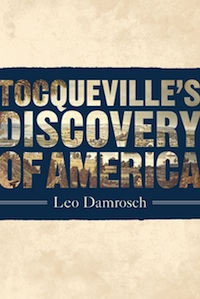
There is something odd about a quintessentially American book having been written by a Frenchman, an oddity perhaps compounded by being one of the most unread well-known titles in American history. Alexis de Tocqueville’s two-volume Discovery of America, published in 1835 and 1840 after the young Frenchman’s nine-month whirlwind tour of 17 of the young nation’s extant 24 states, has become an urtext in studying United States governance and culture. Every so often someone attempts an update or reappraisal—Richard Reeves retraced de Tocqueville’s journey in his 1982 American Journey: Traveling with Tocqueville, and more recently another Frenchman, Bernard Henri Lévy, contributed 2006’s American Vertigo: Traveling America in the Footsteps of Tocqueville.
Now comes Harvard mentor and writer Leo Damrosch (Jean-Jacques Rousseau: Restless Genius) with Tocqueville’s Discovery of America (FSG), a concise revaluation including previously un-translated documents and exhibiting fastidious scholarship. Princeton historian Sean Willentz assesses:
Helping to humanize as well as historicize the young Tocqueville while he was discovering America is the main achievement of Damrosch’s concise and absorbing new book… [It] ought to make a more nuanced appreciation of both the man and his great work accessible to a wide readership… The human young Tocqueville is much more impressive than the cold abstraction, and for helping to bring him to life we are in Leo Damrosch’s debt.
It is worth quoting Damrosch for some context:
Theirs was hardly the most exotic journey of the era—in December of the same year, the 22-year-old Charles Darwin set sail in the Beagle, at a moment when Tocqueville and Beaumont were relaxing on a Mississippi steamboat—but in the context of French culture and politics it was exotic enough. At a deep level, in fact, there was a real similarity between Tocqueville and Darwin. Unlike superficial travelers, they both wrote compellingly because they were so keenly observant—Darwin of the natural world with glances at society, and Tocqueville of society, with glances at nature. And if he was discovering America, Tocqueville had the exceptional insight to grasp the nation was engaged in ongoing self-discovery.
One reviewer concludes: