
The Gutenberg Galaxy
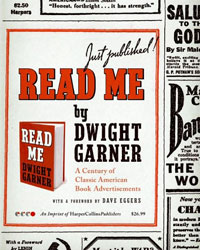
Dwight Garner, who is a devoted book person, reader, and a columnist for the New YorkTimes, has assembled and annotated a compendium of 300 book ballyhoos, entitled Read Me: A Century of Classic Book Advertisements (Ecco).
I had this tome buried in one of those K-2’s of books that festoon my abode for a few weeks, and I repeatedly passed it over before cracking it open. My bad.
I expect this is a book that won’t appeal to a wide swath of readers—which points to its subtlety. It is a brilliant bit of cultural anthropology and literary and publishing history. Garner explains:
Read MeRead Me
Garner points out the current commonplace of video book trailers—which may not be a bad thing, except for that they contribute to the dollars draining from the periodical book sections and publications, which at this end of the tunnel doesn’t look like a promising happenstance.
Publishing mogul Dave Eggers contributes a foreword which exhibits a distinctly Eggerian point of view:
The range of work here is startling and so much of it is wildly eccentric but in a way it’s all kind of unsurprising. It’s unsurprising that publishers have been grabbing people by the lapels promotionally and otherwise for centuries trying to spread the word about books that matter to them. It’s even unsurprising how personal some of the ads are, how pleading and even intimate. Books are personal and intimate things, this we have established, so it follows that the ads promoting them would be personal, eccentric, that the ads would be full of passion and even hyperbole. The makers of these ads have been engaged in nothing less then the preservation of the written word and salvation from the mole men who would like nothing better than, in a bookless world, to feast on our flesh. So consider this book about the most essential undertaking ever by humankind—the creation of ads promoting books—and that, by extension, this book, which collects all the best book ads ever, is the most essential of all books yet created by humans.