
Wind Is Risin'
The assassination-history business in the U.S., while not a thriving enterprise, does provide an occasional narrative from a decidedly warped point of view—though of the successful presidential assassinations, only John Willkes Booth’s and Lee Harvey Oswald’s have spurred countless treatises and analyses. In the main because unlike Charles Guiteau (James Garfield) or Leon Czolgosz (William McKinley), theirs were or were conjectured to be conspiracies, and the killers were not immediately apprehended, which feeds into various conspiracy theories.
For the most part, the stories of would-be assassins such as John Lawrence (Jackson), John F. Schrank (Theodore Roosevelt), Giuseppe Zangara (Franklin Roosevelt), Oscar Collazo and Griselio Torresola (Truman), Lynette “Squeaky” Fromme (Ford), John Hinckley, Jr. (Reagan), and others have faded into the fog of historical arcana. Even other celebrity assassins are now just answers in games of Trivial Pursuit.
(Feel good about your cultural literacy if you know Mark David Chapman, Sirhan Sirhan, Arthur Bremer.)
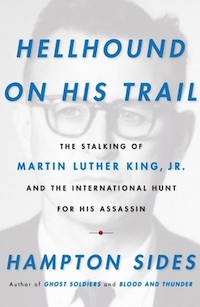
Its certainly been a while since the story of the April 4, 1968 assassination of Martin Lither King, Jr. has been recounted, and Memphis’s own Hampton Sides (Ghost Soldiers and Blood and Thunder) has chosen to engage in a nifty piece of forensic history by unpacking James Earl Ray’s homicidal act in Hellhound on His Trail: The Stalking of Martin Luther King, Jr. and the International Hunt for His Assassin (certainly an apt use of Robert Johnson’s famous song title).
Employing a well-tried approach, Sides explains:
Sides follows Ray, who took the alias Eric Galt, from his perambulations following his release from a Missouri prison in spring of 1967 through the 65-day manhunt conducted (and noted with some irony) by a J. Edgar Hoover-led FBI, spanning Canada, Portugal, and ending with Ray’s arrest in England.
Hampton Sides has admirably succeeded in his efforts by injecting a vitality and urgency into a story that can be accurately labeled a thriller.