
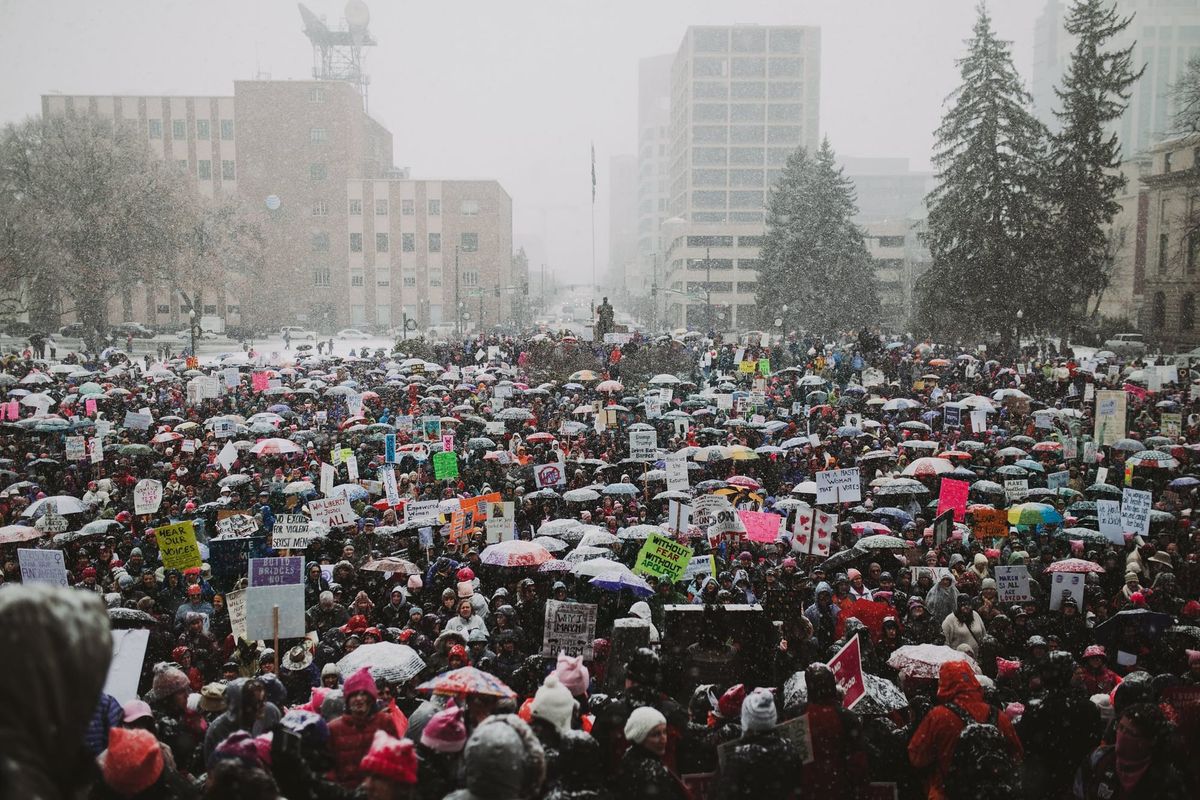
The Women’s March was one for the ages. Where will it go next?
A brief history of America’s marches makes the media look a touch pessimistic
MSNBC’s Lawrence O’Donnell does a short history of inauguration protests to explain why the Women’s March was so significant. “The American news media was not exactly filled with predictions of the protests’ future successes.”
↩︎ posted Jan. 24, 2017
During a time of extreme partisanship and division—a time in which the One America the now-former president once spoke of can seem an ever-more-distant possibility—the Women’s March played out as a kind of alternate-reality inauguration: not necessarily of Hillary Clinton, but of the ideas and ideals her candidacy represented.
“This was a big-tent protest: a messy, ad-hoc, and joyful coalescence of many different movements,” writes Megan Garber.
↩︎ The Atlantic, posted Jan. 22, 2017
Republicans are filing laws in five states that would ban peaceful protests from the streets.
In North Dakota, the proposed law would open big loopholes for drivers who strike protesting pedestrians. Other states have considered “economic terrorism” charges and other anti-picketing measures, all part of a targeted response to Black Lives Matter and anti-pipeline activists successfully blocking roadways.
↩︎ posted Jan. 23, 2017
Marching was easy. Translating momentum into political action is the hard part.
There’s a good reason Dr. King’s last book was called Where Do We Go From Here? As every good organizer knows, follow-up is one of the hardest parts of activism. And after the success of Saturday’s march, there are lots of questions about where that momentum goes next.
While some see parallels with Russia’s anti-Putin protests that went nowhere, organizations are already looking to skill up enthusiastic volunteers. “Organizations need to be ready to receive the protesters when they’re ready to take the next step.”
↩︎ posted Jan. 23, 2017
A slideshow of good signs from Saturday’s marches.
↩︎ posted Jan. 23, 2017
Saturday’s marches by the numbers.
21: Renditions of “Happy Birthday” sung by protesters to a policewoman serving on her special day.
6: Age of Sofie Cruz, immigration activist who melted hearts and called for all to “fight with love, faith, and courage.”
3: Times larger the crowd was on Saturday than Friday in Washington, according to crowd experts.
430,000: More Metro trips taken on Saturday than Friday in Washington.
-20: Degrees Fahrenheit in Fairbanks, where 2,000 marched.
5: Million people estimated to participate worldwide.
32: Trump’s approval rating at the time of the march.
↩︎ posted Jan. 23, 2017
The New York Times assembles photos from Women’s Marches held around the world on Saturday, indeed on every continent.
↩︎ posted Jan. 22, 2017
Demonstrations are most effective when they have a tangible goal, and organizers must be flexible in adapting tactics to the requirements and constraints of a situation.
History lessons on disrupting Trump from “jawsmith” Elizabeth Gurley Flynn, a forgotten IWW leader who called in allies of color and foregrounded women’s rights, education, and civil liberties.
↩︎ Jacobin, posted Jan. 23, 2017
Linda Sarsour, one of the co-chairs of the Women’s March on Washington, began her life in activism by lobbying for the inclusion of Muslim high holy days on the New York City school system’s holiday calendar.
↩︎ posted Jan. 22, 2017
The march really was historically big, but history also shows numbers don’t guarantee success.
An examination of marches in American history reveals a mixed record of success, often delayed. It took 20 years to see any results from the massive 1987 gay rights march, for example.
Here’s a neat map of marches, protests, and rallies that have taken place in Washington over the past century, that gives some context on size. The March on Washington was smaller than Saturday’s march, while the Million Man March was bigger.
↩︎ posted Jan. 23, 2017
“The history of anti-fascist action is not one of polite protest, nor failed appeals to reasoned debate with racists, but direct, aggressive confrontation.” Such as decking Richard Spencer right as he starts to explain Pepe? Some remixes here, including a rare instance in which a certain Bruce Springsteen song is used in a politically appropriate way.
↩︎ posted Jan. 23, 2017