Britain never feels like an island so much as on BBC Radio 4 in the early morning. “Viking. Wind: East or southeast three or four increasing five or six. Sea State: Slight or moderate. Visibility: Moderate or good, occasionally very poor.” Sea conditions for each of the British coast’s nautical areas—Tyne, Dogger, Fisher—are broadcast for 12 minutes, four times daily, on “The Shipping Forecast.” Read with measured, military enunciation, the reports conjure battered masts, Navy decks, and rugged men with the sense to rely on GPS rather than an 80-year-old broadcast. But it’s not read for them. Instead, it’s for suburban listeners sitting at home—in Loughborough, perhaps, or Todmorden—people who protested a few years ago when the BBC proprosed to shift the midnight broadcast by 12 minutes. For these ardent listeners, the language of the sea is an incantation, a lullaby link to another time.
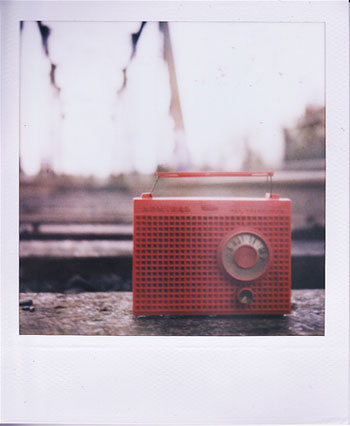
When I moved to England a few years ago, a friend gave me a portable radio as a welcome gift. It was a retro-looking silver rectangle with a collapsible antenna, something I’d never owned in the U.S. My friend insisted I listen to the “Today” program; “Start the Week” was also good. A classmate laughed fondly when suggesting “I’m Sorry I Haven’t A Clue,” and I decided that my cultural education would come from radio rather than television. It was wilful self-delusion: Listen to Radio 4 and the country that emerges is witty and engaging, well-read if parochial, always up for a walk to the pub down the lane. Watch Channel 5 on TV and you see a nation obsessed with home repairs, footballers, and the Botoxed winners of Big Brother. Radio gave me the England I’d gotten to know reading Evelyn Waugh, and that I half-expected to find.
In my yellow South London kitchen the radio sat on the counter, and I would flick it on along with the crusted electric kettle and listen to the news over breakfast. The window above the sink faced sunken tracks running from the Southwest to Waterloo Station, and streaks of white, blue, and orange trains gusted by in rush hour. Beyond was the first of many rows of dismal brick terraced houses—beige and white, the colors of London. A cream-colored milk truck, peeling rust around the wheels, parked at the corner, its frame inches above the asphalt. The weather seemed forever the same: a heavy gray sky sagging above the power wires, the air smelling of wet dirt and leaves. “Today,” the morning news show, plays through this memory of a London dawn and fills out the picture of my kitchen.
News in the U.K. was more entertaining than in the States, especially with “Today’s” tough interviewers openly insulting their powerful guests. I remember John Humphrys grilling the embattled Deputy Prime Minister, John Prescott:
Isn’t the problem this: that you are the Deputy Prime Minister—that job requires a certain amount of dignity in its holder. The view is that you have lost that dignity, and in the views of many people, that you have become a bit of a figure of fun. You know that as well as I do. Is it tenable that you should hold on under these circumstances?
The afternoon shows, on the other hand, vied for most obscure. “Poetry Please”—this week, focusing on wildlife poems. “The Afternoon Play”—Frank’s rhubarb business goes belly up and he’s on the dole. And the delightfully arcane “Gardeners’ Question Time,” where the banter must only make sense to a handful of rural pensioners:
“You know, it’s funny, on the program we’re always being asked for something that will block a view, that will stop at six or seven feet, and [japonicus] is one of the few plants that will be there quickly and will stop at six or seven feet—”
“Yeah well so will Japanese Knotweed, but you wouldn’t plant that, would you?”
[Laughter]
Comedy programs, though, were so unlike anything in America that I would sit in a chair and listen with my full attention, as if living in the ’30s. Monday nights were for “Just a Minute,” where “four exciting, talented panelists show their command of language, their verbal dexterity, and their wit as they try to speak on a subject for one minute without hesitation, repetition, or deviation.” The program featured panelists like the deadpan Clement Freud, former member of Parliament and grandson of Sigmund, or the actor Stephen Fry. The chairman gives contestants a subject—“life begins at 40” or “druids”—and they buzz each other for slips. It’s the sort of drollery I had come to expect of England, but never encountered in the pub. Instead people there talked about football or read sensational headlines from the Daily Mail. Radio 4 diddled above gloomy everyday life in a Britain as fantastic in some ways as Waugh’s or Monty Python’s, broadcasting to a country that was largely a generation-old memory.
Radio gave me the England I’d gotten to know reading Evelyn Waugh, and that I half-expected to find.Now back in the U.S., I stream Radio 4 through the internet, which connects me to my former home. Stirring oatmeal at the stove, I listen to “The World at One,” and a distant Big Ben rings the hour. “The Conservative leader demanded a general election.” Long, open vowels sound from a grey London afternoon. I turn the heat down under the pot, pour coffee, glance at the New York Times. “The Prince of Wales received £3 million from the taxpayer last year.” The sun rises above the tall buildings of downtown Brooklyn to the east, misting through the window. “The Commons has a new Speaker to keep order in the House.” The cool tenor of the host, his measured pauses and bright transitions, fills my morning kitchen with one o’clock purpose.
Radio, unlike television, is what you play while doing other things. It weaves into daily life, rather than suspending it, becoming the background noise to washing up or making tea. With the cadences of the “Today” program I picture where I was when I listened to it in England, looking out at the heavy sky and the shingled rooftops, the sound of an ambulance, a lopsided scream, drifting through the window. Then I hear the horn of the Staten Island Ferry, and for a second I am in both London and New York, each carrying me through breakfast.