
Cagey Men
For the purpose of this communiqué I don’t need to resolve whether myth-making is both a necessary and sufficient ingredient of nationalism—let’s agree that it is at least a sufficient condition.
Hence, the various fabricated or embellished narratives regarding the Pilgrims and their Native American hosts, the notion of happy-go-lucky black slaves whistling Dixie, Davy Crockett and the Alamo, Custer’s final encounter with the Sioux, manifest destiny and the U.S. imperative to bring democracy and Christianity to those not blessed, and so on, are also important telltale signs of a less acknowledged reality.
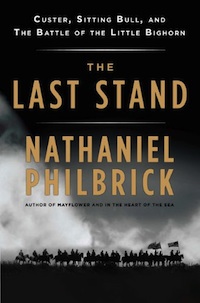
Perhaps the most famous and romanticized incident in U.S. history is what is ignominiously referred to as Custer’s Last Stand (more accurately entitled The Battle of the Little Bighorn). Already well documented and accounted for—Evan Connell’s Son of the Morning Star (1984), M.A. Elliot’s Custerology: The Enduring Legacy of the Indian Wars, George ArmstrongCuster (2007), and countless TV and film representations to name but a few—now add Nathaniel Filbrick’s The Last Stand (Viking Press) as the newest entry to an already copious bibliography.
Philbrick begins:
Philbrick (Mayflower: A Story of Courage, Community, and War) reconstructs a taut narrative that takes into account that despite the Lakotas’ victory in battle, it was also a last stand for warrior chief Sitting Bull and his Plains Indian cohort, and, for what it is worth, contextualizes this sorry episode in subsequent American history. As such it is a useful monograph, and Philbrick, as he has shown in his past histories, is a vivid storyteller.