
Permanent Error
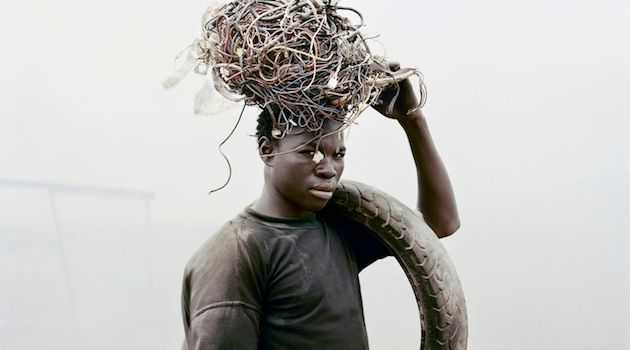
On the outskirts of a Ghana slum, young people work in toxic conditions to extract metal from melted-down computers—technology that we've discarded, and shipped elsewhere for the dirty work of recycling.
On the outskirts of a Ghana slum, young people work in toxic conditions to extract metal from melted-down computers—technology that we've discarded, and shipped elsewhere for the dirty work of recycling.
The post-post-apocalyptic cityscape will see houses built in hammocks, and neighborhoods bound by chains. If you’ve ever felt that urban living depends on a wing and a prayer, welcome home.
The owners of exotic or unconventional pets in Alex Arzt’s “Human-Animal” photographs range from nurturing to obsessive. Challenging our assumptions about the human and animal worlds, Arzt’s work reminds us that ownership of other species is a uniquely human trait.
Photographs that ask why romantic relationships should look the same. For example, why can’t one partner be a piece of homemade sushi?
These meticulous, stylized portraits have the visual lure of advertising, but they’re not selling anything, merely asking you to look.
Sanna Kannisto’s photographs go behind the scenes of the natural sciences. A test tube full of nectar enticing a bat to pose for the camera is as beautiful and instructive as any textbook image or documentary film.
America primarily knows China as a faraway giant, a country of industrialism and megalopolises somewhere over there. Shen Wei's monograph and series Chinese Sentiment gives us new views and brings the country closer, with more mystery and less smog. (Some images NSFW)
There is a simmering intensity to Iké Udé’s portraits—which feature subjects ranging from himself, to fashion designer Manolo Blahnik, to financial executive Reggie Van Lee—show a highly stylized world of color, attitude, and object, making their domain as much anarchic as covetable.
These x-rays of ancient and contemporary artwork were created to serve as a tool for art historians and conservators, but their ethereal yet familiar silhouettes become something more in David Maisel’s photographs.
Costco is cheap. Convenient, even, but should it be the subject of fine art? Here, the aisles of Home Depot and Target are the landscapes of the 21st century.