
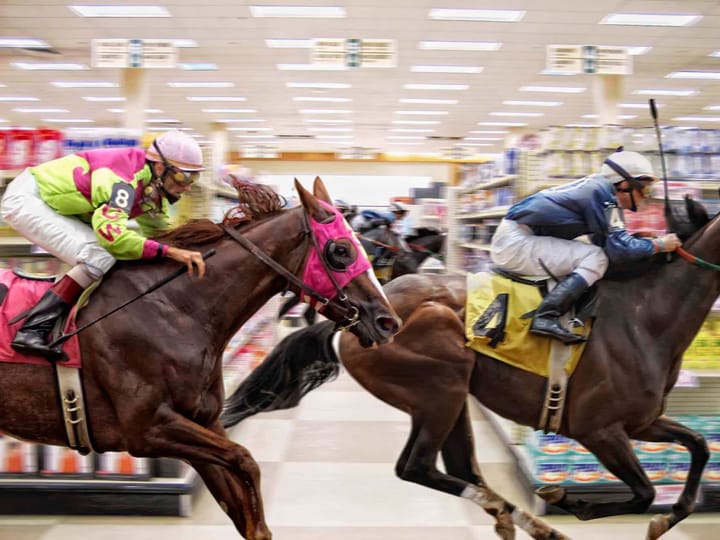
Bracketology for the 2016 Tournament of Books
Announcing the brackets for the 2016 edition of The Morning News Tournament of Books, presented by Field Notes.
Announcing the brackets for the 2016 edition of The Morning News Tournament of Books, presented by Field Notes.
The typical American consumes more than 100,000 words a day and remembers none of them.
A couple’s decision to combine bookshelves supplies a series of revelations.
When insomnia and technological convenience collide, a lifetime of binge reading reaches its full potential.
A generation of women read the “Harry Potter” series as teens, “Twilight” in college, and “Fifty Shades of Grey” in their twenties. What is the cumulative effect?
Good books are frequently credited with being worth reading twice. But when was the last time anyone had time for that?
As New York City changes, so do its trains; our worries about life above and below ground move hand in hand. So which came first, the jitters or the subway?
Good book clubs rely on commitment, Sauvignon Blanc, and the pruning of members with annoying habits. Unfortunately, sometimes those members are homicidal maniacs.
This is it, friends—the last round of our Reading Roulette series of contemporary Russian literature in translation, with one shot left in the chamber. But we’ve saved the best for last.
Today we're launching a new series of contemporary Russian literature, with six stories in six months, including interviews with their authors, sponsored by Powells.com. Will one of them blow your mind? We begin with the "Queen of Russian Horror."
Our Man in Boston sits down for this third conversation with author, critic, and book-world majordomo Sven Birkerts to talk about the current reviewing situation, the best books of 2000, and Amy Winehouse.
When you’ve long been identified as a “literary type,” how can it be that receiving books as get-well gifts leaves you feeling empty, angry, and determined to chug YouTube straight?
Today, from 2-3:00 p.m., the Biblioracle will use his magical powers to recommend the next book you'll love. Prior to that, a call-to-arms to save the plight of reading and an announcement about the 2012 Tournament of Books reader-judge contest.
You are what you read. For some, that means 22 boxes of books. Facing a storage crisis of bibliolatry proportions, our writer surveys e-readers and a life spent reading.
If not for a tragic car accident in 2001, W.G. Sebald would be celebrating his senior citizenship next week. Recalling an obsessive introduction to the author's unclassifiable genre.
I haven’t read T. Jefferson Parker’s books for a while, though when I spoke with him in the mid-’90s I was favorably impressed with his writing. Along with Michael Connelly, Thomas Perry, Don Winslow, and Robert Ferrigno, Parker is one of a handful of crime writers who
There is much anecdotal evidence to support the view that despite America’s vast riches (yes, even now) we are still in thrall to a lifeboat mentality. On the other hand, the nongovernmental response to disasters such as Katrina, the tsunami, and numerous earthquakes are a sign, as Mark Twain
I recently noted British bad-boy photographer Martin Parr’s slip-cased, two-volume Parrworld:Objects and Postcards, the latter volume of which displayed Parr’s 5,000-strong postcard collection. Now comes a (relatively) new Walker Evans book—Walker Evans and the Picture Postcard by Jeff Rosenheim (Steidl)—and an exhibition of Evans’
Like Art Spiegelman, I have an aversion to the rubric “graphic novel.” Golden Globe-winning Israeli film Waltz With Bashir was first an animated film and now also exists as a 128-page book (Metropolitan Books)—novel, comic book—do you care? In both iterations it is a powerful story based on
As I was reading and immensely enjoying Through Black Spruce (Viking), Canadian author Joseph Boyden’s newest opus, I came to the realization that I never read something by a Canadian writer that I didn’t find pleasing. That is a topic for another time, but Through Black Spruce reminded
I view those books concerned with writers’ love lives and how that affected their work at large with at least detachment and perhaps even skepticism—though unquestionably I respect the efforts in writing and getting a book published. In Faulkner and Love: The Women Who Shaped His Art (Yale University
The Manny Ramirez story seems to have a wider audience than just local baseball chatter, and may even go off track and venture into the quagmire known as human relations. Living in the belly of the beast—the heavily monetized snake-oil brand known as Red Sox Nation—I have been
Assuming you have not been totally co-opted and reduced to an incidental node in the circuitry of the faceless conspiracy known as the WWW, it’s possible you may have some feeling for the idea of a personal library. You know, real books, on some semblance of shelving or containment,
Some years ago in a conversation with the then-ebullient Thisbe Nissen, a recent spawn of the famous (Iowa) Writers’ Workshop, I asked—as I am occasionally prone to do—if there was a writer I should look out for. Her answer was Wake Forest mentor John McNally. McNally (The Book
Except for movie and music concert art of the late ’60s (JZ Lynch, R. Crumb, Skip Williamson), posters have not occupied as prominent a place in American culture as in the rest of what is called western civilization—for some reason, Puerto Rico has refined poster art and reproduction to
No doubt in the publishing world there is a lingering hope that books specific in topic—bread-baking, quilting, knitting, bird-watching—have application to the broader project of the life well-lived—as in Zen and the Art of Motorcycle Maintenance. Which is, of course, a most un-Zen-like precept. Things are what
Thomas Perry’s The Butcher’s Boy and Metzger’s Dog are two of the best books of whatever niche/genre in which you place Perry’s fiction. He is also known for a best-selling series devoted to Jane Whitfield, a woman of Native American ancestry whose talents and specialty
Luckily, only a quartet of so-called small (literary) magazines have chosen to subscribe me. Any more and I am certain I would have to start making ruthless and painful decisions about my reading queue. I see such magazines as the victory gardens, boutique vintners, and truck farms of America’s
A few American writers have captured the desolation and despair of the areas in America afflicted by ravages of post-industrial decline—Russell Banks and Richard Russo come to mind. Now comes Philipp Meyer’s debut novel American Rust (Spiegel & Grau), set in a distressed rust-belt town near Pittsburgh, and
Most of my adult life—what I will in my memoir (in progress) call “The Post-Graduate Years," I have, when given the opportunity, railed against the poor or lack of attention with which Americans regard their history. Except for a small number of re-enacters, scholars, and so-called buffs (most
Though I hold no fondness for softcover/paperback books, I am enthralled by so-called pocket books, the dimensions of which are approximately four inches by seven inches. Perhaps I have been mesmerized by the mother of all such books, Quotations From Chairman Mao Zedong or The Little Red Book, which
How does one wake up every day with a strong imperative to look for some strand of meaning from the frayed reality that relentlessly presents itself to our punch-drunk (collective and perhaps individual) consciousnesses? Wait, don’t answer that. My guess: by partially fashioning one’s own narrative with usable
These days Africa seems to be the epicenter of misery stories—if not the planet’s epicenter of misery. Which makes Malawi-born (kudos if you can point to Malawi on a map) conceptual artist Samson Kambalu’s memoir, The Jive Talker: An Artist’s Genesis (Free Press), a literary refreshment.
[Photo by Robert Birnbaum] Inclement weather may have scuttled my chat this week with multifaceted writer Lawrence Weschler, but I want to take the opportunity to bang the drum loudly about the republication and updating of his early works on Robert Irwin and David Hockney, as well as the rest
These days I must admit a preoccupation with matters of history and gloomy concerns about our country’s governance. Despite being a failed scholar of history—as in, lacking the cojones to take on a doctoral program—I still pay attention to historiography and accessible scholarship. I have in the
In this current wave of hopeful historiocity (sic) comes a fine new book for children of all ages that splendidly arrays American history. The National Children’s Book and Literary Alliance conceived and curated Our White House: Looking In Looking Out (Candlewick Press), a collection of essays, personal accounts, historical
When Barack Obama mentioned 106-year-old Ann Nixon Cooper in his inspiring victory speech, he utilized a device (if I can call it that) suggesting the immediacy of history through the narrative lens of a very old person/survivor—which has been employed to excellent use in a number of outstanding
It makes good sport to speculate on the men and women worthy of placement in the pantheon of world historical figures. In the 18th century and beyond, Swiss-born Jean-Jacques Rousseau, author of The Social Contract, has been awarded such stature—the French actually exhumed his body from Jean-Jacques’s chosen
Sometime in the mid-’90s, in a conversation with British writer William Boyd, I offhandedly asked if he wanted to name a writer he thought deserving of wider recognition. “Justin Cartwright,” was his answer. I, with great singleness of purpose, went to Avenue Victor Hugo Bookshop (sadly, the brick-and-mortar shop
Possibly the next fad in literature will see an upswing of publishing Scandinavian crime-story writers in the U.S.A. Stieg Larsson (The Girl With the Dragon Tattoo) has been hugely successful; Peter Høeg has a following here; and now Jo Nesbø (The Red Breast) reaches these shores with Nemesis
Sometime last year, I commended the George Pelecanos-edited The Best American Mystery Stories 2008, which included a riveting story by Floridian Kyle Minor, “A Day Meant to Do Less.” It turns out Dandy Dan Willett’s fledgling imprint Dzanc Books is publishing Minor’s debut collection, In the Devil’s
Afghanistan, frequently referred to as the burial ground of empires or somesuch, may well turn out to be Barack Obama’s pivot point to a second term—and the United States’s long downward spiral into oblivion. Based on his campaign assertions, he would seem be continuing the naïve view
The holiday (publishing) hiatus did not much change my reading habits other than two glorious days spent in total horizontal bibliophilic repose. I was able to read Louisianan writer Tim Gautreaux’s new opus, The Missing (Knopf), which doesn’t quite rise to the level of his gripping The Clearing,
Annie Leibovitz is arguably the best-known photographer in the U.S.A. (Who else? Richard Avedon? Herb Ritts? Ron Gallela?) Based on years of service at hippie-qua-boomer journal Rolling Stone, where she shot 142 covers, and her ongoing work at effete boomer glossy Vanity Fair, as well as other such
One might wonder why three Mormon historians—Ronald W. Walker, Richard E. Turley, and Glen M. Leonard—chose to investigate an unarguably black mark on the Mormon religion and published those results, some 150 years after the fact. Whatever the reason, Massacre at Mountain Meadows (Oxford University Press) is an
Over Spanish painter Joan Miró’s (1893-1983) long and storied career he spent more than a decade in aggressive experimentation with material, media, and subjects--"I want to assassinate painting”—and it is the transformative period from 1927 to 1937 that is the focus of an exhibition at New
Before I picked up Vanity Fair’s Michael Wolff’s (Autumn of the Moguls) new opus, The Man Who Owns the News: Inside the Secret World of Rupert Murdoch (Broadway Books), I was dubious about wanting to spend untold hours finding out about the “secret” world of short-fingered vulgarian Murdoch.
Some months ago I received an anthology from a heretofore unknown (to me) publisher, Bellevue Literary Press. Apparently I have been blessed to remain on their mailing list, as I have continued to receive their offerings. Of late I am a fortunate recipient of Iowa Writer’s Workshop graduate Paul
I am going to risk casting a pall of pedantry on this breezy corner of literary terrain and mention that late last millennium the term “meta” floundered onto the periphery of pop culture, even appearing in a space-filling essay in the New York Times Book Review. Apparently English majors did
If I had not spoken with expatriate (he lives in Vienna) American writer Jonathan Carroll a few years back, I might be surprised that his online biography is bilingual (English-Polish); nor does it surprise me that, though he has authored nearly 20 well-received novels, he has managed to remain relatively
A handsome volume by Columbia College (Chicago) mentor and Nelson Algren-award-winning writer Joe Meno (Hairstyles of the Damned), Demons in the Spring (Akashic Books) anthologizes 20 pieces of short fiction, some never previously published and each illustrated by artists, including Charles Burns, Ivan Brunetti, Archer Prewitt, Jay Ryan, and Cody
Whether it's political nonfiction, extraterrestrial erotica, or some combination thereof, we hold our genres dear. The TMN readers and writers reveal their favorite works from the back of the shelf.
Even before the grand finale of the 2008 election campaign, new books on the only other president elected from the great state of Illinois, Abraham Lincoln, were much in evidence in reviews and bookstores. No surprise there, as somewhere in his forthcoming tome, Angels and Ages: A Short Book About
Poetry As Insurgent Art (New Directions), a slender (90 pages), pocket-sized, clothbound volume with the title embossed on the black coverboard is a work in progress (the earliest version transcribed from a KPFA radio broadcast in the late ‘50s) by octogenarian poet patriarch LawrenceFerlinghetti. Ferlinghetti has been amending and publishing
As an expatriate Chicagoan living in benighted eastern Massachusetts, I can attest to the geographical affliction prevalent in these and other parts of the East Coast that are apparently blind and ignorant of the United States west of Philadelphia—this year being an exception given the importance of funny sounding
I was searching for video of one of my last visits to Chicago’s Grant Park; that trip took place in August 1968, when Sen. Eugene McCarthy walked across the street from the Conrad Hilton Hotel and addressed the gathered crowd as “the United States government-in-exile.” Though I couldn’t
Though he is the author of more than 20 worthy tomes that range over a broad literary landscape—novels, essays, biographies, histories—eagle-eyed cinephile DavidThomson is likely best known for a number of editions of the incomparable and valuable A Biographical Dictionary of Film and recently The New Biographical Dictionary
Given the titans residing in the pantheon of aphorists—Oscar Wilde, Karl Kraus, G.K. Chesterton, Ludwig Wittgenstein, Dorothy Parker, Mark Twain, Ambrose Bierce—it takes a writer of high self-regard or no sense of history to attempt a book of aphorisms. Or like poet, editor, musician, and Scotsman Don
The decision by the Christian Science Monitor to no longer print a hard-copy version got me to thinking about my reading habits vis-à-vis that great American news appliance, the daily newspaper—and I was pushed into a state of befuddlement, realizing I had not picked up a piece of newsprint
In the end, it is difficult to view perennial Countdown “Worst Person in the World” candidate and Fox Network blabbermouth Bill O’Reilly as anything other than a blustering clown with a deep streak of the bully in him. Why then, you ask, have I engaged in the selfless service
[Photo by Robert Birnbaum] Having grown up in Chicago I had the great good fortune to be introduced to Studs Terkel’s work early on—as well as the other Chicago wonders, all hidden in plain sight from the rest of America—Mike Royko, Ernie Banks, Curtis Mayfield, Sid McCoy,
The venerable and imaginative Yale University Press, which publishes a cornucopia of wonderful titles each year, including many groundbreaking art tomes (or so-called “coffee-table books”), has commissioned a series of monographs under the rubric Icons of America, of which—to give you a sense of its parameters—King’s Dream
Controversial British photographer and Magnum member Martin Parr, who was once derided by Magnum founder and photographic titan Henri Cartier-Bresson as “from another planet,” is also known as a collector and historian of photography books—he numbers his collection at around 7,000 volumes—hence the two volumes of The
I don’t know about others (though the common default explanation is some variation of attention deficit) but my reading habits have seemingly transformed into something unrecognizable to the Me of just a few years ago—perhaps even before the post-millennial chattering class preoccupation with announcing and sifting through the
Though never far from my thoughts, the Central American nation of Nicaragua, to which I traveled in 1989, does manage occasionally to penetrate the American cultural noise machine--most recently with a reissue of much-lauded photographer Susan Meiselas's monograph, Nicaragua. For me this is an excuse to revel in
In our heavily industrialized civilization, we have rightly placed a great value on handmade, original one- or few-of-a-kind goods. For Handmade Nation: The Rise of D.I.Y., Art, Craft, and Design, which is the textual offshoot of a film project due for release next year, Faythe Levine criss-crossed the
Though I am not an admirer or enthusiast of Boston writer Dennis Lehane, who is best known for the novel on which Clint Eastwood based his film Mystic River--I have never quite comprehended the plaudits he has garnered--I did appreciate his recent novel Shutter Island. And now comes his doorstop
Which superpower regularly exports inferior goods, infiltrates other economies, has a questionable human rights record, and preemptively wars against other sovereign nations? Strong evidence can be presented that the U.S.A. fits that bill, but let's go with the conventional view and name the People's
In some fashion you all, no doubt, celebrated Banned Books Week (Sept. 29-Oct. 6), the American Library Association’s annual celebration of the freedom to read. How, you are asking, might one celebrate? The A.L.A. suggests you read or reread one of the top 100 challenged books of
Apparently we are heading to an important election and many citizens and various aliens of all stripes, eyes, and ears are being besieged by the various soothsayers, talking heads, and comedians who make their living mediating American and world politics for the rest of us. Personally, I find our leap-year
Perhaps it is too obvious that the manifold pleasures of the world (as well all manner of infelicities, not to mention horrors) mostly come at you without introduction or warning. Max is a compelling film starring John Cusack as Max Rothman, an Austrian Army veteran who lost an arm at
It is not beyond reason to assert that the small segment of humanity devoted to the written word can be further divided into those who find reading as an escape or departure from the real day-to-day world and those for whom it is, in part, a lens with which to
As little attention as is paid to literature in the United States—apparently we have greater matters with which to deal—Canadian writers are rarely acknowledged (Alice Munro excepted) down here in the lower 48. Andrew Pyper has a good chance of breaking through the caribou curtain with his fourth
Like many right-thinking Americans, I have been sporting a 1-21-09 sticker on my front bumper for a few years. That date, enlightened citizens will acknowledge, is the last date of the Bush/Cheney presidency—an administration that has more than its share of tell-all tomes and Bob Woodward faux exposés.
With nearly 30 books of novellas, novels, stories, essays, poetry, and food and travel writing under his ample belt, one might expect Jim Harrison’s name to have to have wider currency, at least among smart folks that read books. Yet, despite being translated into more than 20 languages and
For those people who attempt to claim the world of fine art is distinct from the commercial one, sullied by filthy lucre and other crass venal motives, this book may be hard to swallow as it clearly and definitely exhibits the blurring of what arguably are archaic categories—though even
If you remember (as I do) or are not long removed from your reiterated adolescence—known, in America, as your undergraduate years—you will recall all manner of silly affectations, excessive tastes, and dramatic postures, soon overcome by the rigors and demands of so-called real life. For me, in that
When floating through post-collegiate limbo, you can use an anchor. Recalling when a very large book played a very large role in life.
As we have seen over the weekend, an untimely death (such as they are) of a prodigious young talent is a shock to the system. Francisco Goldman, who did great journalism in Central America in the 1980s and has written a number of well-regarded novels including The Divine Husband, suffered
One of the benefits of doing literary journalism is the sporadic largesse of book publishers; as a recipient of daily deliveries, one of the more fun and pleasing byproducts of that is the opportunity to pick a book at random from the towering biblio-stacks and dipping into the pages to
There is an open question on what character flaw or personality disorder causes me to lord over people who don’t know anything about Nicaragua or at least where it is located. No doubt it will be given ample consideration in my memoir (current working title: Just Talking: How to
This time around—it being an election year and all—a hurricane’s landfall stole the G.O.P.’s most recent thunder. This time, the threat of another deadly disaster got through to our lame-duck president and the major networks. And obviously New Orleans and the Gulf Coast offer
Growing up in the shining city on the plains—Chicago—early on in my life I encountered the dark and shocking story of Leopold and Loeb’s crime: In 1924 two University of Chicago students, Richard Loeb and Nathan Leopold, Jr., killed, with no apparent motive, 14-year-old Bobby Frank. One
In fits of attempting constructive self-criticism (also known as navel-gazing), I ponder the possibility that my disaffection with mainstream politics and my lifelong drift from left-leaning liberal to socialist to anarchist is mostly a result of my biography. That probably is supposed to matter, especially to people who think that
[Photo by Robert Birnbaum] I was a reader of Robert Stone (A Hall of Mirrors, Dog Soldiers, A Flag for Sunrise, Children of Light, as well as assorted entries in Harper’s—one on Havana and one on the 1988 Republican National Convention in New Orleans) before I knew anything
Though I dipped into Louis De Bernières’s Colombian Trilogy (The War of Don Emmanuel’s Nether Parts, The Troublesome Offspring of Cardinal Guzman, Señor Vivo and the Coca Lord) it was not until Captain Corelli’s Mandolin (the basis for an awful film by the same name) and a
You all know, or will learn now, that I admired Kurt Vonnegut a great deal—an admiration that began and lasted past my youthful, stupid years into my golden, stupid years. I was looking for some information about Kurt and stumbled upon a note from his daughter, Edie. Res ipsa
Receiving an advance copy of The Best American Mystery Stories 2008—guest-edited this year by George Pelecanos—reminds me that Houghton Mifflin’s onslaught of its franchise The Best American Series anthologies is not far behind. What started in 1915 as simply The Best American Short Stories now has every
The ubiquity of digital cameras and the avalanche of images whose lives are wholly lived on hard drives, as well as other aspects of 21st-century visual aesthetics, make black-and-white photography seem like some arcane ritual practiced in far-off time by god-artists named Walker Evans, Henri Cartier-Bresson, Dorothea Lange, Diane Arbus,
I suppose one might be amazed at the subjects that fill the hundreds of thousands of books published each year—and though I don’t want to sound jaded, I must say that I am no longer. Though, of course, many books give me pause for a lingering inspection of
Cartoonists have struggled in the American culture for their rightful seat at the big arts banquet of popular culture—the big shift in their legitimacy can probably be pegged to Art Spiegelman’s Pulitzer Prize-winning graphic novel Maus in the late ’80s. Back in the mid-20th century, parents who were
Last year, when word went out that Kate Winslet and Leonardo DiCaprio were once again sharing the silver screen in a film based on Richard Yates’s Revolutionary Road, I was pushed along a path of once again coupling films made from important or at least imposing novels. Yates, by
Based on an impressively large body of work and awards from people who care about such things, one can say Lawrence Block is a big thing in the crime story universe. But I came upon his work through a well-realized film, 8 Million Ways to Die by Hal Ashby (his
A few months ago I was pleased to note James Sturm’s America: God, Gold, and Golems. Now comes a new opus and collaboration. Arguably, baseball is best consumed as a game for boys and girls of all ages and frequently attempts to make more much of it ring false
Any number of things, mostly of a serendipitous nature, bring certain books into focus—life being very much a kaleidoscopic succession. In this instance, Amy MacKinnon’s debut novel, Tethered, is adorned by a colorized version of Toni Frissell’s wonderful 1949 photograph “Lady in the Lake,” which I first
Roxana Robinson, who recently published a novel, Cost, with noteworthy blurbs and which received good notices and appreciative reviews, is a skilled literary fiction practitioner whose compact body of work includes two previous novels, three story collections, and a biography of painter Georgia O’Keeffe. None other than Robert Stone,
I must note that my sense of the people who are popularly characterized as conservatives—officials and pundits—is that they are not coherent enough to be judged as anything other than loonies and comedians and carnival barkers. I have in mind as the prototypical American conservative George Will and
Despite a recent loss, I do have some books for you to heed. You can take my word for it—in any event, it’s the only word I am capable of at this moment—that they are worth your attention. 1. The Black Hole War: My Battle with Stephen
It’s really noisy out there. “Conservative bloggers jab Obama on foreign languages.” (Huh?) Christie is getting divorced. There is a new cell phone. Angelina had twins. Microsoft cut the price of the Xbox 360. Freddie, Fannie, and Bernie Mac are a mess. Brett Favre wants to un-retire. There’s
As a talking head, George F. Will does present himself as an arid and smug and, dare I say, tight-sphinctered Caucasian. His writing, though (except for his humorless desiccations of baseball), suggests a thoughtful, erudite thinker who is the class of the comedians, flying monkeys, and holy rollers known as