
We are Mainly Ians & Ans
Last week we published a link in our headlines wherein we used the word “Indianaian” to describe a person from Indiana. This, according to our eagle-eyed copy editor, Kate Schlegel, was a misspelling; we should have actually used “Indianian.” (The default dictionary in Microsoft Word, on a third hand, insists upon the vowel-disavowing “Indianan.”)
A conversation in IM ensued:
Andrew Womack: Alright, I fixed it in the headlines. Thanks for catching that.
Kate Schlegel: No problem. I’ve actually got a list of every state’s resident name.
Andrew Womack: No way.
Kate Schlegel: No, really, it’s true. Check your email.
So I did. And learned:
Andrew Womack: Wow.
Kate Schlegel: Told you.
Andrew Womack: Impressive list. It’s actually “Texian,” though.
Kate Schlegel: Ha. No.
Kate Schlegel: I like “Michigander.” I wonder what they’d all look like mapped out, like on a map of the U.S.?
Andrew Womack: Hmm.
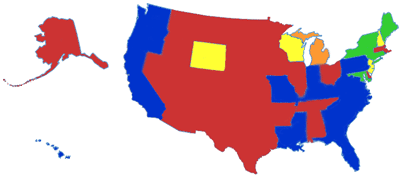
key: -ans (red), -ians (blue), -ers (green), -ites (yellow), -ders (orange)
While the majority of states—and the meat of the central and central-west U.S.—go with “-an” to describe their residents, second place easily goes to the “-ian” suffix, favored on the west coast, the southeastern states, and as far north as Pennsylvania. People who are “-ers,” however, are entirely housed in the northeast. The ending “-ites” appears to have no regional basis, and the lovely “-ders” are only found in Michigan.
During this exercise, a pair of emails arrived from Indianians, both of which alerted us that, thank you very much, people from Indiana are not “Indianians,” nor are they “Indianans,” but, in fact, are “Hoosiers.”
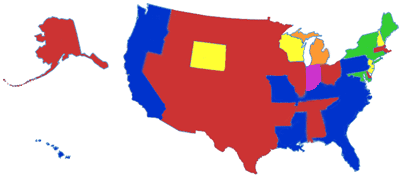
key: -ans (red), -ians (blue), -ers (green), -ites (yellow), -ders (orange), Hoosiers (purple)