
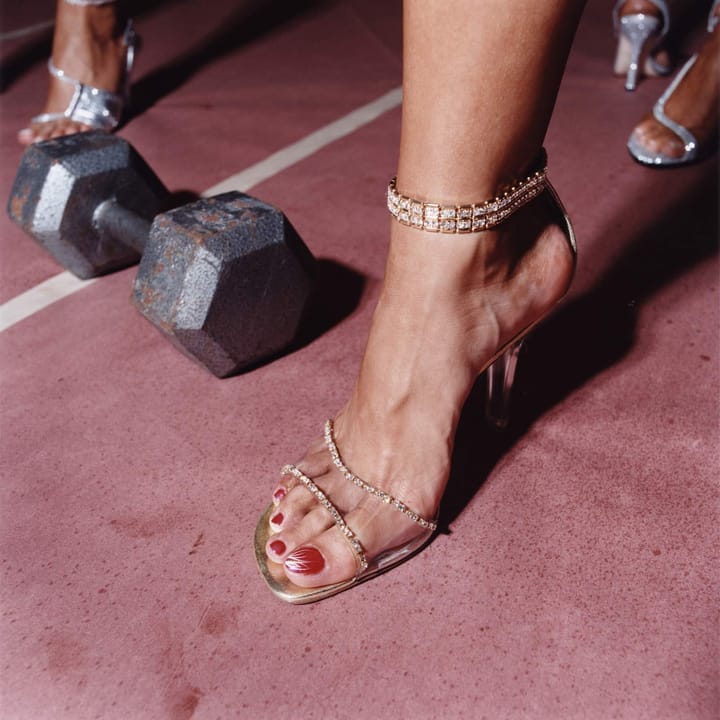
Powerlifter
Traditionally ostracized in the weight room, women who dare to lift weights discover strength they were previously denied.
Traditionally ostracized in the weight room, women who dare to lift weights discover strength they were previously denied.
What one journalist learned by vicariously sitting in on David Carr’s master class—with only his teacher’s reputation, extant syllabus, and students’ recollections to guide the way.
For the mother of a serial killer, a chance to connect with victims on live TV offers a shot at redemption.
This summer’s ongoing war between Chief Keef and Rahm Emanuel is as much about urban history as holograms.
America is a proud nation of immigrants—try telling that to everyone on the other side of the door. Life as a white-collar undocumented immigrant in New York.
The staff choose their most-liked pieces published in 2014: a painting expedition through the Underground Railroad, a personal memory of Vivian Maier, and a restaurant review that isn’t a restaurant review.
At an Elvis festival in rural Canada, scores of tribute artists (not "impersonators") pay homage to the King. When searching for the meaning of it all, try not to overthink it.
It's the most wonderful time of year, but for atheists and agnostics, it means something altogether different. We asked a group of non-believers to tell us how they’re spending their secular holiday seasons.
Twice the official portraitist of George W. Bush, painter Robert Anderson explains what it’s like to build a relationship with a president, separate the man from the legacy, and struggle with his smirk.
Orangutans are some of humans’ closest relatives, genetically. They also rarely exhibit aggression, despite how we've abused them. One is different.
A man dies, leaving behind, among other things, a combination lock. Opening it may just prove the existence of the afterlife.
Mainstream country music is dominated by bros singing about girls in cutoffs and drinking tequila. But some female country artists are ready to exchange fire.
Sinclair Lewis despised his hometown in Minnesota. It disliked him, too, especially after being lampooned in a bestselling novel that mocked the citizens for their small-town ways. These days, though, he's all they've got.
A gentleman in 1720 could read Greek while mounting a running horse. Today’s gentleman reads GQ in the bathroom. From rapists to stylists, a history of the American gentleman.
The staff choose their most-liked pieces published in 2013: a trip to Patsy Cline's divided hometown, the complete biography of North West, a cold case of hit-and-run, and no shortage of great quotes about dead bodies.
An American ballerina makes headlines when she says the Bolshoi Ballet wanted a bribe to let her perform. The company denies her accusation. But a small library in Virginia knew about it first.
Dirt is difficult to see on glass. That’s why so many people don't bother to hire a professional for the job—they just can’t see what’s wrong.
Economic recession. Climate disaster. Chaos in the Middle East. The world cries out for leaders who will face our biggest dilemmas, and all we get are short-sighted narcissists. Where are the great leaders of today?
In early New England, anyone who stood near an open door or window faced mortal danger. A conversation with a woman who hunts for gravestones with epitaphs describing death by lightning strike.
At one school, the popular girls were called the “chicken patties,” but the jocks were just the “jocks.” How teenage crowds get named.
In the late 1870s, baseball was at risk of dying out before it even got started, strangled by a teetotaling, law-abiding, church-going new league. Then a German saloonkeeper in St. Louis got involved.
When a cocktail is born, it receives a name. How it’s christened has as much to do with the drink’s lineage as the bartender’s mood—and sometimes, how it makes you feel after you’ve finished it.
For residents of Patsy Cline’s hometown of Winchester, Va., the struggle over how to remember the famous country singer begins with deciding what sort of a legacy she left—and whether they want it.
This week, Detroit’s new emergency manager released his first report on the city’s dire affairs. But residents have long been accustomed to life in what’s essentially a failed state. A native author meets the motorcycle men working hard to save Detroit, one fiend at a time.
As anyone who’s struggled to start a band, get shows, record music, and become a certified rock star knows, coming up with a name is half the challenge. A linguistic take on how we name bands today.
On Nov. 28, 1966, the SS Daniel J. Morrell capsized during a storm, taking 28 of its 29 crewmen to the bottom of Lake Huron. The sole survivor of a Great Lakes shipwreck tells his tale.
Personal collections groomed over decades gather signs of Bigfoot, the Loch Ness Monster, and other hidden animals—crumbs of a fuller truth preserved by citizen scientists. One such collection in Maine is open to the public.
A young crooner’s untimely, macabre death left questions for those who would follow—musicians and fans alike. Was it suicide? Was it a hit? A listener's query into one star's place in the history of early rock and roll.
For decades, the U.S. government banned medical studies of the effects of LSD. But for one longtime, elite researcher, the promise of mind-blowing revelations was just too tempting.
As “Mad Men” enters its much-anticipated fifth season, the New York psychotherapist who consulted on the show’s development explains why its characters and storylines feel so ineffably real.
Today marks the 75th anniversary of H.P. Lovecraft's death. From Stephen King's It to “The Call of Cthulhu,” a survey of the 20th century's greatest horror writer's afterlife of influence.
Hank Williams III blew the doors off country music last fall when he released three ambitious, experimental albums all on the same day. A conversation about tradition, hardcore, and punishment.
An unfinished autobiography and a 1980s biopic turned Frances Farmer, one of the great golden-era stars, into a lobotomized zombie. The main trouble: Frances Farmer wasn’t lobotomized. An investigation to set one of Hollywood’s most convoluted stories straight.
Tao Lin and his band of followers at Muumuu House are some of the most vehemently disliked—and discussed—writers on the internet. Critics call them hip. Haters call them frauds. But their fiction may be just what our digital lives deserve.
Florida is America’s most-abused state, and Tallahassee its biggest target for bi-coastal writers who pick low-hanging fruit—rednecks, old people—and wouldn’t know an alligator from their elbow. The slander has gone far enough. On behalf of every Tallahussey and T-Town man, let the corrections begin
Our man in Boston and Jim Shepard, the author most recently of You Think That's Bad, discuss whacko projects, researching short stories by jet, and how much gold it takes for a writer to dump Knopf's Gary Fisketjon.
Allan Seager was a student at Oxford when he contracted tuberculosis. What happened next made him one of America's greatest writers—declared the heir to Anderson and Hemingway—ever to be forgotten. Yet one of Seager's short stories endures in ways that none of Hemingway's can match.
We live in the golden age of all-female tribute bands, from Sheagles and Blonde Jovi to AC/DShe and Cheap Chick. Here we present an anatomy of a scene, with Judas Priestess—from women who pioneered stoner/doom rock to teenagers playing Alice Cooper drum solos at Philadelphia's rock academy.
Our man in Boston sits down with the extremely likeable Arthur Phillips to chat about everything, including his latest novel.
Our man in Boston sits down with the author of the "Berlin Noir" trilogy and other books, to talk about detectives, Nazis, and Impressionist writing.
A decade after Osama bin Laden's face achieved iconic status, one writer still can't help thinking, it's a handsome one—this definitive "face of evil."
As America dreams of black ops teams, where do mutants belong? And can comics end wars? From Captain America to big blond Thor, Osama bin Laden, and beyond.
From Schwarzkopf’s boots to traffic cones, the federal government’s official color palette—yes, it has one—controls much of what we see. An investigation into how America elects to paint itself.
Our man in Boston sits down with writer Andre Dubus III to discuss the differences between memoir and autobiography, Harvard and UMass students, and when it is inappropriate to send an email.
Our man in Boston talks with memoirist and historian Carlos Eire to discuss Cuba and Operation Peter Pan, when 15,000 children were airlifted away from their parents.
Does your minor want to be a miner? How about a McNugget cook? Welcome to KidZania, a revolutionary theme park coming soon to the U.S. that lets kids play at corporate-sponsored employment.
Our man in Boston sits down with author Gretel Ehrlich to talk about daily life in the Arctic Circle, good wine, Tom McGuane, and how to go online from an off-the-grid cabin in Wyoming.
Our man in Boston sits down with Scott Spencer, author most recently of Man in the Woods, to talk about writing, dogs, and show business.
Our man in Boston speaks Mary Roach, author most recently of Packing for Mars, about severed-hand fan mail, writing in an office, and Coke in space.
Our man in Boston talks to the author of Super Sad True Love Story about writing in the near-future, signing readers' e-readers, and abusing a six-foot bong.
Norman Seaman was one of New York’s great avant-garde supporters. In his biography, he said, John and Yoko would only get a chapter.
After 26 years writing Harper’s Notebook, Lewis Lapham talks about history, essays, and modern journalists.
Our man in Boston talks with author (and TMN contributor) Jessica Francis Kane about a tragedy during the Blitz that's the focus of her new novel, The Report.
Our man in Boston sits down with author and New Yorker editor Ben Greenman to discuss independent publishing, the edges of art, and Celebrity Chekhov.
Few people want jury duty, but at least most jurors seated for trial get the satisfaction of passing judgment. For one writer, being an alternate becomes a tale of miscarried justice.
Our man in Boston sits down to chat with author Jennifer Egan about her new novel, A Visit From the Goon Squad, and what it's like to write in PowerPoint.
Ten years after their first conversation, author David Mitchell and our man in Boston discuss 18th-century Japan, shoplifting from other novels, and Mitchell's annual Christmas party.
A conversation with Australian novelist Richard Flanagan about the erosion of book culture, Nicole Kidman's genius, and souls that are ever underline-able.
Our man in Boston goes the distance with author and New Yorker editor David Remnick in a conversation about President Obama, magazine publishing, and American Idol.
Celebrity graduation speakers should dispense wisdom and entertainment, or cause a scandal. Our writer found eight who managed to provide at least two out of three.
Last month's suicide attacks in Moscow shocked anyone who studied Dzhanet Abdullayeva's photo. But it wasn't her baby face or cold blood that impressed our writer. It was her choice of metro stations.
As India considers saving seats for women in the government’s upper tier, a tour of the country’s rural east shows how quotas have turned women into local politicians.
Joe Franklin is a New York institution, having interviewed untold celebrities and been (jokingly) accused of rape by Sarah Silverman.
Thomas Jefferson’s heart’s work was to carve out a little Eden on a small mountaintop. Visiting Monticello again and again and again.
Where politics and democracy fail, nature eventually wins. A number of tyrants and world leaders are currently sick. Ranking the illest.
Our man in Boston talks to Michael Ondaatje about why he writes novels, how he measures satisfaction, and when fiction can succeed by operating like poetry.
Writer seeks pen name: something simple, nothing dippy, and preferably one that avoids implying a lawyer who savors puns.
Our man in Boston talks to Tobias Wolff about the art of revision, how writing programs are good for training skilled readers, and why Robert Olen Butler still signs stock.
For agents and publishers, the Frankfurt Book Fair is publishing's biggest event: part conclave, mostly marathon, and all business. It is absolutely no place for an aspiring author, as we discover.
Following up with targets of the infamous Rock Critical List, an anonymous, highly personal screed that sparked a firestorm.
The turntablist now known as DJ Premier got help at critical moments in his rise from a piano-playing childhood in Houston, and these days he's looking to spread the love.
For people who lived near the World Trade Center, 9/11 can still be traced to debris that lingers around the neighborhood. A map of what the tourists don't see.
Our man in Boston chats with author Gil Adamson about Toronto's literary mafia, the fact-checking that plagues novelists, and the difficulty of listing 10 Canadian writers.
Churchill Downs is like no other sports event, considering sports are barely involved. Our writer attended her first Derby last year with a family of committed fans and survived to tell the tale.
Our man in Boston talks with novelist Joseph O'Connor about writing historical fiction, the role of the Irish in the American Civil War, and the trouble of trilogies.
Beethoven said Handel was the greatest who ever composed—so why do we only seek him out at holidays? Marking the 250th anniversary of Handel’s death with a guide to all the life in his music.
Though his hair frequently resembled mid-'70s Rob Reiner, his gaze was more erratic. On the occasion of Gogol's 200th birthday, tracking the evolution of his visage.
As winter wanes, everyone grows tired of the cold and damp, whether they live in San Francisco, Austin, or London. A day in the life of TMN's editors and writers on the first day of spring.
In a wide-ranging discussion, our man in Boston talks with novelist and skeptic James Howard Kunstler about life as it is, life as it could be, and life as we may encounter.
Bangkok's image as a city for sex, knife fights, and cobras is burnished to a shine. A trip home finds some of that, but mostly it's ghosts--real ones--and they're not quiet.
More than four decades into his career as a rock mentor, Iggy Pop talks about getting back with the Stooges and finding a daily rhythm that suits him.
Professional opera singer, mountain climber, race car driver, and Vladimir Nabokov’s best translator and collaborator, Dmitri Nabokov has led an impassioned life.
Lots of machines can manufacture things. What about one that could produce everything, including itself? Visiting the man who taught a machine to replicate.
Early hardcore was characterized by frontmen like Black Flag's Henry Rollins, who had the perseverance and genius to rise above convention. But as Rollins tells it, change is less an event than a lifelong process.
Straight from Boston, a conversation with author Amy Bloom on her latest book, Away, the benefits of the writing life, and the tedium of extra-long novels.
Parents can seem larger in life to their children, but some truly are giants. Recounting the death of her stepfather, for whom nothing was easier by being freakishly big.
Our man in Boston sits down with author Elizabeth Strout to talk about Maine, her latest novel, and the plights of the modern writer. Now with audio excerpts.
Parents love to appear unannounced on a grown child’s doorstep. Rarely, though, do they ship 12 cartons of belongings to precede them.
There's a movement afoot to rewrite rock’s best songs with Christian lyrics, and you haven’t heard about it. Enter the world of “parodeities,” and learn some Deuteronomy.
Emails have about as much room for nuance as Post-It notes, and less staying power. But sometimes they’re pure poetry.
Having spent a quarter-century pushing Americans to face the music, the former Dead Kennedys vocalist sits down to tell his thoughts on Obama, political parties, and participatory democracy.
The worlds of professional wrestling and contemporary fiction aren’t so far apart. Our writer immerses himself in the Total Nonstop Action Wrestling Federation, to the point of being flung across the ring.
The estimable Chip Kidd, designer of books' fronts, backs, and spines, chats with our man in Boston about what it's like to work on the words that come in between.
Gary Gygax, the co-creator of Dungeons & Dragons, passed away this week. A gaming enthusiast remembers how the discovery of a game opened a new world of imagination and fun.
Three novels under his belt, Arthur Phillips sits down for a chat with our man in Boston about his commitment to fiction writing and, a challenge on quite another level, finding the discipline to focus on one piece at a time.
Rosemary's Baby author Ira Levin died this week--and it wasn't a lousy book review that killed him.
The jazz chanteuse talks about meeting a legend, experimenting with styles, and finding her own voice.
When the New York Times architecture critic Herbert Muschamp died recently from lung cancer, America lost one of its most riveting writers--one of the best critics we've ever had, and quite possibly among the worst.
Many of us imagine killing our bosses; some people actually take it a little further. Meet a woman who got into the massage business to avoid a homicide rap.
The accuracy of Fox's new police drama K-Ville can only be known by the cops working in post-Katrina New Orleans. An interview with Police Lieutenant Bryant Wininger, who explains where the real drama still is, free of storylines and plot twists.